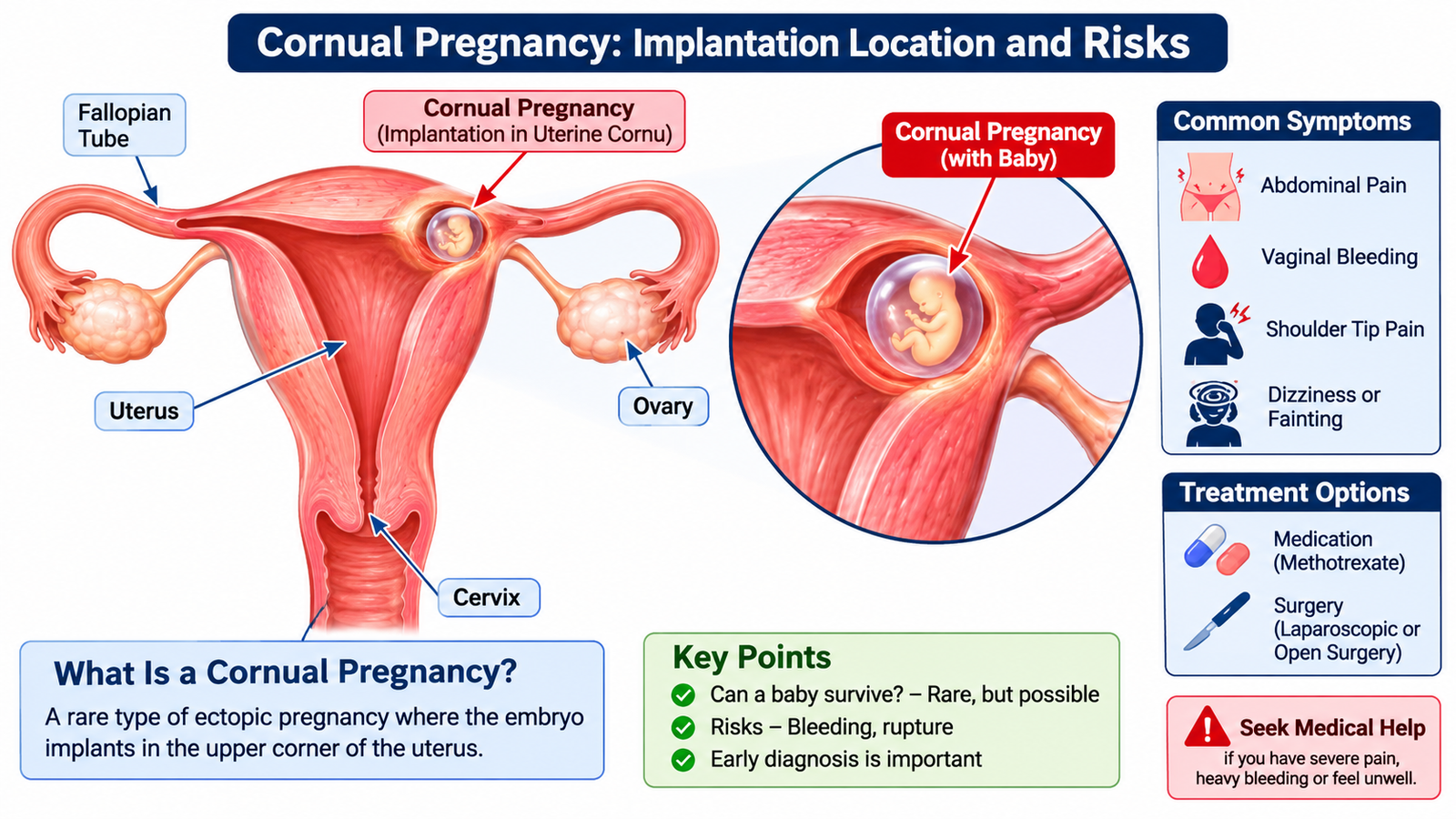
Cornual Pregnancy Baby: Can the Baby Survive? Risks, Symptoms and Treatment
A cornual pregnancy is a rare type of pregnancy that develops near the upper side of the uterus, close to where the fallopian tube enters the uterine wall. It is often discussed alongside interstitial pregnancy, although these terms do not always describe exactly the same condition.
One of the most common questions families ask is: Can a baby survive a cornual pregnancy?
The answer depends on the exact implantation location and the mother’s medical condition. In exceptionally rare cases, a pregnancy diagnosed as cornual or interstitial has progressed far enough for a baby to be delivered alive. However, this is not the usual outcome, and the condition can cause life-threatening internal bleeding.
Understanding the diagnosis is essential. This guide explains the possibility of baby survival, early warning signs, ultrasound findings, treatment options and future pregnancy considerations.
What Is a Cornual Pregnancy?
A cornual pregnancy describes a pregnancy implanted in the upper lateral region of the uterus. Historically, doctors have sometimes used this term interchangeably with interstitial pregnancy.
However, modern medical terminology makes an important distinction.
An interstitial pregnancy develops in the part of the fallopian tube that passes through the muscular wall of the uterus. A pregnancy in a rudimentary horn develops in an underdeveloped section of a uterus with an unusual shape.
These conditions are different from a normally implanted pregnancy located toward the upper side of the uterine cavity.
The distinction matters because an interstitial ectopic pregnancy can rupture and cause severe internal bleeding, while an eccentric intrauterine pregnancy may have a completely different prognosis.
Where Does a Cornual Pregnancy Develop?
The uterus has two upper corners, called the uterine cornua. Each corner is connected to a fallopian tube.
In an interstitial pregnancy, the fertilised egg implants within the narrow portion of the fallopian tube that passes through the uterine muscle.
This area can stretch as the pregnancy grows, sometimes allowing the pregnancy to remain undetected longer than other tubal ectopic pregnancies.
Unfortunately, stretching does not mean that the pregnancy is safe.
Is Cornual Pregnancy the Same as Interstitial Pregnancy?
Not necessarily.
The terms are frequently confused, but they have different anatomical meanings.
| Pregnancy type | Implantation location |
|---|---|
| Interstitial pregnancy | Portion of the fallopian tube inside the uterine muscle |
| Rudimentary horn pregnancy | Underdeveloped horn of an abnormally formed uterus |
| Angular or eccentric intrauterine pregnancy | Within the uterine cavity, near its upper lateral corner |
| Typical intrauterine pregnancy | Within the normal uterine cavity |
A specialist ultrasound assessment is important to distinguish these conditions correctly.
Can a Baby Survive a Cornual Pregnancy?
Yes, there have been rare documented cases in which a baby survived an interstitial or cornual pregnancy.
However, survival is exceptional and should not be considered an expected outcome.
The major concern is that an interstitial pregnancy develops outside the normal uterine cavity. The surrounding uterine muscle and blood vessels may be unable to accommodate continued pregnancy safely.
As the pregnancy grows, the area can rupture and cause severe internal bleeding.
Documented Cases of Baby Survival
Medical literature has published unusual cases of successful delivery following pregnancies diagnosed as cornual or interstitial.
For example, a 1999 case report described a woman who presented at approximately 30 weeks of pregnancy with internal bleeding caused by a small rupture. Doctors performed surgery and delivered the baby, who survived after spending 39 days in a special care baby unit.
Another case, published in Obstetrics & Gynecology in 2013, described a viable baby delivered by caesarean section from an interstitial pregnancy that had not ruptured at the time of delivery.
These reports demonstrate that survival is biologically possible in exceptional circumstances. They do not establish that continuing an interstitial pregnancy is safe.
What Determines Whether a Baby Can Survive?
Several factors influence pregnancy outcomes:
- Exact implantation location: A normally implanted eccentric pregnancy has a different prognosis from an interstitial ectopic pregnancy.
- Gestational age: The stage of pregnancy affects fetal development and the possible complications of premature delivery.
- Uterine condition: The thickness and strength of the surrounding tissue can influence the risk of rupture.
- Maternal health: Blood loss, internal bleeding and other complications can threaten the mother’s life.
- Early diagnosis: Identifying the pregnancy location promptly helps doctors choose appropriate treatment.
The mother’s safety remains the priority in every treatment decision.
Why Is Cornual Pregnancy Dangerous?
An interstitial pregnancy is dangerous because it can grow within the muscular wall of the uterus, an area with a substantial blood supply.
If the pregnancy ruptures, the bleeding can be severe and develop quickly.
Possible complications include:
- Internal abdominal bleeding.
- Uterine rupture.
- Severe abdominal pain.
- Haemorrhagic shock.
- Emergency surgery.
- Blood transfusion.
- Damage to surrounding reproductive structures.
- Loss of the affected pregnancy.
In severe cases, uncontrolled bleeding can become life-threatening.
Why Can Rupture Happen Later?
The interstitial portion of the fallopian tube is surrounded by uterine muscle. This surrounding tissue may allow the pregnancy to expand for longer than a pregnancy in some other parts of the fallopian tube.
As a result, symptoms may not appear immediately.
However, a later presentation does not mean the pregnancy is developing normally or safely.
This is one reason why early pregnancy assessment is particularly important.
Symptoms of Cornual Pregnancy
Symptoms can vary from one person to another. Some women initially experience symptoms similar to an ordinary early pregnancy.
Common warning signs include:
1. Abdominal or Pelvic Pain
Pain may occur on one side of the lower abdomen or pelvis. It can begin mildly and become more severe.
2. Vaginal Bleeding
Light bleeding or spotting may occur. Some women mistake it for an unusual menstrual period.
3. Shoulder Tip Pain
Pain at the tip of the shoulder can occur when internal bleeding irritates the diaphragm.
This symptom requires urgent medical assessment, particularly when accompanied by abdominal pain or dizziness.
4. Dizziness or Fainting
Internal blood loss can reduce blood pressure and cause weakness, dizziness or fainting.
5. Severe Sudden Pain
Sudden, intense abdominal pain may indicate rupture and internal bleeding.
Emergency warning: Severe abdominal pain, shoulder-tip pain, fainting, collapse or heavy bleeding during pregnancy require immediate emergency medical care. Do not wait for a routine appointment or another home pregnancy test.
How Is a Cornual Pregnancy Diagnosed?
Early diagnosis is essential for reducing complications.
Doctors generally use a combination of medical history, physical assessment, blood tests and imaging.
Transvaginal Ultrasound
A transvaginal ultrasound is one of the most important investigations.
It allows doctors to examine the uterus, fallopian tubes and surrounding structures in greater detail.
Possible findings include:
- A gestational sac outside the main uterine cavity.
- A thin layer of uterine muscle surrounding the pregnancy.
- An interstitial line sign.
- An unusual relationship between the gestational sac and the uterine cavity.
- Signs of internal bleeding.
Three-dimensional ultrasound may also help clarify the implantation location in difficult cases.
Beta-hCG Blood Test
Beta-human chorionic gonadotropin (beta-hCG) is a pregnancy hormone measured through blood testing.
Doctors may repeat the test after approximately 48 hours to understand how hormone levels are changing.
However, beta-hCG levels alone cannot confirm the exact location of a pregnancy.
MRI Scanning
In selected cases, magnetic resonance imaging (MRI) can help clarify complicated uterine anatomy or uncertain ultrasound findings.
It is not routinely required for every suspected cornual pregnancy.
Why Specialist Assessment Matters
A pregnancy near the upper corner of the uterus is not automatically ectopic.
Misdiagnosing a normally implanted eccentric pregnancy as an interstitial ectopic pregnancy can lead to inappropriate treatment.
An experienced early-pregnancy specialist or maternal-fetal medicine consultant should assess uncertain cases before treatment whenever the patient’s condition allows.
Treatment Options for Cornual Pregnancy
Treatment depends on the pregnancy’s location, size, gestational age, symptoms, evidence of rupture and the mother’s overall condition.
There is no single treatment suitable for every patient.
1. Medical Treatment
Methotrexate is a medication used in selected cases of ectopic pregnancy.
It works by stopping the growth of rapidly dividing pregnancy tissue.
Doctors may consider it when the patient is medically stable and the clinical findings meet appropriate treatment criteria.
However, it is not suitable for every interstitial pregnancy. The presence of fetal cardiac activity, pregnancy size, hormone levels and other clinical factors influence treatment decisions.
Close follow-up is necessary.
2. Laparoscopic Surgery
Laparoscopic surgery involves making small abdominal incisions and using a camera and specialised instruments.
Depending on the situation, the surgeon may remove the pregnancy and repair the affected area.
Possible procedures include:
- Removal of the affected portion of the fallopian tube.
- Removal of the pregnancy tissue.
- Repair of the uterine muscle.
- Other procedures based on the patient’s anatomy and bleeding risk.
3. Open Abdominal Surgery
If the pregnancy has ruptured or severe bleeding is present, doctors may need to perform emergency open surgery.
The main objective is to control bleeding and protect the mother’s life.
In some severe cases, removal of the uterus (hysterectomy) may be necessary, although doctors try to consider fertility-preserving options when medically safe.
4. Treatment of a Rudimentary Horn Pregnancy
A pregnancy in a rudimentary uterine horn requires a different assessment from an interstitial pregnancy.
Surgical removal of the pregnant horn is often recommended because of the significant risk of rupture.
The exact procedure depends on the uterine anatomy and the patient’s condition.
Can a Cornual Pregnancy Continue to Full Term?
This question requires careful explanation.
A true interstitial ectopic pregnancy is not considered a safe pregnancy to continue. Although rare live births have been reported, the risk of rupture and severe maternal bleeding remains a major concern.
A pregnancy that appears cornual on an ultrasound may instead be an eccentric intrauterine pregnancy. Such a pregnancy may sometimes continue normally under specialist monitoring.
Therefore, the first step is establishing the exact location.
Doctors should not make decisions based solely on the word “cornual” in an ultrasound report.
What Is the Difference Between a Cornual and Angular Pregnancy?
These terms are often confused because both describe pregnancies near the upper sides of the uterus.
However, their anatomical locations are important.
An angular or eccentric pregnancy is located inside the uterine cavity, close to its lateral corner.
An interstitial pregnancy is implanted in the portion of the fallopian tube that travels through the uterine muscle.
This distinction can significantly affect the expected outcome.
Some studies have reported encouraging live-birth outcomes for selected eccentric intrauterine pregnancies. Those findings should not be applied to true interstitial ectopic pregnancies.
A specialist should interpret the ultrasound findings rather than relying on terminology alone.
Can You Get Pregnant Again After a Cornual Pregnancy?
Yes. Many women can become pregnant again after treatment for an ectopic pregnancy.
However, future fertility depends on several factors, including:
- The type of surgery performed.
- Whether the uterus was repaired.
- The condition of the remaining fallopian tube.
- Any underlying reproductive health problems.
- Previous ectopic pregnancies.
- The extent of uterine damage.
A previous cornual or interstitial pregnancy does not automatically mean that a woman cannot have children in the future.
How Soon Can You Try Again?
The appropriate waiting period depends on the treatment received.
After methotrexate, doctors generally recommend waiting at least three months before trying to conceive, following the treating specialist’s advice.
After surgery, the recovery period may differ depending on the procedure and the condition of the uterus.
Before attempting another pregnancy, it is important to discuss future conception plans with a gynaecologist.
Monitoring the Next Pregnancy
Women with a previous ectopic pregnancy may need early assessment during their next pregnancy.
Doctors may recommend:
- Early pregnancy blood tests when appropriate.
- An early transvaginal ultrasound.
- Confirmation of the pregnancy’s location.
- Specialist monitoring if uterine surgery was previously performed.
Early assessment helps identify another ectopic pregnancy before serious complications develop.
Emotional Recovery After a Cornual Pregnancy
Losing a pregnancy can be emotionally difficult, especially when the diagnosis involves emergency treatment or surgery.
Women and their partners may experience grief, anxiety, fear about future fertility or uncertainty about trying again.
These feelings deserve attention and support.
Helpful steps include:
- Discussing concerns openly with a healthcare professional.
- Asking questions about the diagnosis and treatment.
- Seeking counselling if grief or anxiety becomes difficult to manage.
- Attending recommended follow-up appointments.
- Allowing sufficient time for physical and emotional recovery.
A pregnancy loss is not the mother’s fault. Emotional support is an important part of recovery.
Frequently Asked Questions About Cornual Pregnancy Baby
1. Can a baby survive a cornual pregnancy?
In exceptionally rare documented cases, babies have survived an interstitial or cornual pregnancy. However, the condition carries serious risks, including uterine rupture and life-threatening bleeding. Survival is not the expected outcome.
2. Can a cornual pregnancy reach 20 weeks?
Some reported interstitial pregnancies have progressed into the second or third trimester. However, this does not mean that continuing such a pregnancy is safe. The risk of rupture and severe bleeding remains a major concern.
3. Can a cornual pregnancy reach full term?
Rare case reports describe advanced pregnancies and live births. Nevertheless, a true interstitial ectopic pregnancy is dangerous and should not be intentionally continued as a routine alternative to treatment.
4. Does a cornual pregnancy have a heartbeat?
Yes. An embryo within an ectopic pregnancy can develop detectable cardiac activity. A heartbeat does not establish that the pregnancy is safely located inside the normal uterine cavity.
5. Can a cornual pregnancy rupture?
Yes. Rupture is one of the most serious complications. It can cause severe internal bleeding, shock and potentially life-threatening consequences.
6. Is cornual pregnancy always ectopic?
The answer depends on what the term describes. An interstitial pregnancy is ectopic, while a normally implanted eccentric intrauterine pregnancy is not. This is why accurate ultrasound terminology matters.
7. Can a woman have another baby after cornual pregnancy?
Yes. Many women can conceive again, depending on their reproductive health and the treatment received. Early ultrasound assessment is especially important in a subsequent pregnancy.
8. Is surgery always necessary for cornual pregnancy?
Not every case requires the same treatment. Selected stable patients may be candidates for medical management, while surgery is necessary in many cases, particularly when rupture or significant bleeding occurs. The decision belongs to the treating specialist.
9. What is the survival rate of a cornual pregnancy baby?
There is no reliable universal survival percentage that applies to all pregnancies described as cornual. Studies and case reports often combine different implantation locations, making direct comparisons misleading.
10. Can ultrasound confirm a cornual pregnancy?
Transvaginal ultrasound is the main diagnostic investigation. Three-dimensional imaging or MRI may help in selected uncertain cases. The findings should be interpreted by an experienced specialist.
Conclusion: Understanding Cornual Pregnancy and Baby Survival
The possibility of a cornual pregnancy baby surviving is a subject of genuine medical interest, but it requires a realistic understanding of the risks. Rare medical reports have documented successful deliveries, yet a true interstitial ectopic pregnancy can cause uterine rupture and severe internal bleeding.
Accurate diagnosis is the most important first step. Understanding whether the pregnancy is interstitial, located in a rudimentary uterine horn or normally implanted near the uterine corner can make a major difference to treatment and prognosis.
Anyone with a suspected cornual pregnancy should seek prompt assessment from a qualified gynaecologist or early-pregnancy specialist. Severe pain, fainting or shoulder-tip pain requires emergency care. Early diagnosis and appropriate treatment help protect maternal health and future reproductive possibilities.
Medical disclaimer: This article is intended for educational purposes only. It does not replace an individual medical assessment, diagnosis or treatment plan. Always consult a qualified healthcare professional about pregnancy-related symptoms or concerns.