


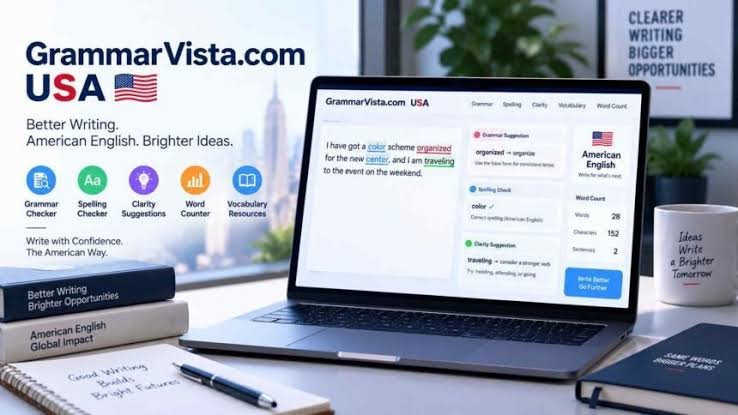
If you searched for GrammarVista.com USA, you are probably looking for a straightforward resource that helps make English writing clearer, more accurate, and easier to understand. GrammarVista.com is an online publishing platform focused on grammar, vocabulary, writing guidance, punctuation, sentence structure, possessives, and related language topics. Its homepage currently describes the site as a place for practical grammar and vocabulary guidance, while its navigation also includes broader informational categories.
The important point is simple: GrammarVista.com should be understood as a general online resource rather than a separate USA-only edition. For readers interested in American English, the site can serve as a starting point for understanding common writing conventions and language questions.
What Is GrammarVista.com USA?
The phrase GrammarVista.com USA can create some confusion because it may sound like the name of a separate American version of the website.
The exact domain is GrammarVista.com, and its current homepage presents Grammar Vista as a resource offering guidance on grammar and vocabulary. The site’s listed categories include grammar, punctuation, compound words, possessives, and sentence structure.
For someone searching from the United States, the practical question is less about finding a separate American website and more about finding clear English-language guidance that works for U.S. writing situations.
That distinction matters.
American English has its own spelling conventions, vocabulary preferences, punctuation habits, and everyday expressions. A useful language resource should help readers understand those differences instead of treating every English variety as identical.
GrammarVista.com USA and American English
American English is one standard variety of English used throughout the United States. It shares the fundamental grammar of other major English varieties, but differences appear in spelling, vocabulary, punctuation, and some usage patterns.
Consider a few familiar examples:
| Writing Area | Common American Form | Common British Form |
|---|---|---|
| Spelling | color | colour |
| Spelling | center | centre |
| Spelling | favorite | favourite |
| Transportation | truck | lorry |
| Housing | apartment | flat |
| Transportation | elevator | lift |
| Vacation | vacation | holiday |
| Fuel | gasoline | petrol |
| Sidewalk | sidewalk | pavement |
| School writing | grade | year/form in some contexts |
These differences do not mean one variety is universally superior. Consistency is usually more important than choosing one variety over another.
A U.S. business document will normally benefit from American spelling and vocabulary. A document prepared for a British audience should follow British conventions.
Why Grammar Matters in Everyday Writing
Grammar is sometimes treated as a school subject that disappears after graduation.
It does not.
People use grammar every time they write an email, submit an application, publish a website, prepare a report, create an advertisement, answer a customer, or send a professional message.
A small grammatical mistake can change meaning.
Compare:
“The manager approved the proposal.”
with:
“The managers approved the proposal.”
The change from singular to plural affects who performed the action.
Another example:
“Your account is ready.”
versus:
“You’re account is ready.”
The second sentence uses you’re, a contraction of you are, where the possessive adjective your is required.
These are simple examples, but they demonstrate why grammar resources remain useful for experienced writers as well as beginners.
GrammarVista.com USA for Grammar Questions
One of the most useful ways to approach GrammarVista.com USA is as a reference point when a particular English question creates uncertainty.
Instead of memorizing hundreds of isolated rules, writers can organize common problems into categories.
1. Subject-Verb Agreement
The verb should agree with its subject in number.
Correct: The student studies every evening.
Incorrect: The student study every evening.
With plural subjects:
Correct: The students study every evening.
This basic pattern becomes more difficult when additional words appear between the subject and verb.
For example:
The collection of books is on the table.
The subject is collection, not books. That is why is is appropriate.
2. Pronouns
Pronouns replace nouns and help avoid repetitive writing.
Common problems include confusing:
- your / you’re
- their / there / they’re
- its / it’s
- who / whom
- whose / who’s
These pairs deserve special attention because some forms sound identical when spoken.
3. Verb Tense
Verb tense tells readers when an action occurs.
Compare:
She works from home.
She worked from home.
She will work from home.
A longer paragraph can become confusing when the writer changes tense without a reason.
Strong editing therefore involves checking tense consistency across the entire passage, not just individual sentences.
4. Articles
English uses a, an, and the in ways that can be difficult for learners.
Examples:
- a university
- an hour
- the report
- an important decision
- a useful tool
The choice between a and an depends on sound rather than simply the first written letter.
That is why we write an hour but a university.
Punctuation: Small Marks, Large Effects
Punctuation tells readers how sentences should be interpreted.
A comma can separate items, clauses, or introductory material. A period signals completion. A colon can introduce an explanation or list. A semicolon can connect closely related independent clauses.
Consider:
Let’s eat, Grandma.
The comma changes the sentence dramatically compared with:
Let’s eat Grandma.
The second version is grammatically interpretable but has an entirely different meaning.
For professional writing, punctuation should support readability rather than simply decorate the page.
Sentence Structure and Clarity
A grammatically correct sentence can still be difficult to read.
That happens when a sentence contains too many ideas, excessive modifiers, unnecessary words, or an unclear logical structure.
For example:
The company, which had been operating in the region for many years and had recently changed its management structure, decided after several meetings that were held throughout the summer to expand its services.
The sentence is technically understandable, but the reader has to work.
A clearer version might be:
The company had operated in the region for years. After several summer meetings, its new management team decided to expand services.
Same basic message. Less friction.
This is why sentence structure and grammar should be considered together.
Compound Words and Possessives
GrammarVista.com’s listed topic areas include compound words and possessives.
Compound words can appear in several forms:
- Closed: notebook
- Hyphenated: well-known
- Open: real estate
Usage can depend on the word, grammatical position, and established style.
Possessives create another common problem.
For a singular noun:
the student’s book
For a regular plural noun ending in s:
the students’ books
For an irregular plural:
the children’s books
The apostrophe is doing real grammatical work. It is not simply punctuation added wherever ownership appears.
Vocabulary: Choosing the Right Word
Good writing is not about using the biggest word available.
It is about selecting the word that communicates the intended meaning precisely.
Consider:
assist and help
Both can be correct, but they may produce different tones.
Likewise:
purchase and buy
The first may sound more formal, while the second is often more natural in ordinary conversation.
Writers should consider:
- meaning
- audience
- tone
- context
- formality
- regional usage
A business proposal, school assignment, product description, and personal email may communicate the same basic idea using very different vocabulary.
Who Can Benefit From GrammarVista.com USA?
A grammar and writing resource is not limited to students.
Students
Students can use grammar references when working on essays, assignments, presentations, applications, and other academic writing.
The most useful approach is to understand why a correction is necessary rather than copying a corrected sentence without learning the rule.
Professionals
Workplace communication creates constant opportunities for language mistakes.
Emails, reports, proposals, customer messages, internal documentation, and presentations all benefit from clear wording.
A simple grammatical error can make a professional message appear rushed or poorly reviewed.
Job Seekers
Resumes and cover letters require particular attention because the writing represents the applicant before an interview takes place.
A strong resume does not need complicated vocabulary. It needs concise descriptions, consistent formatting, accurate grammar, and specific evidence of experience.
Website Owners and Content Creators
Online publishers have another challenge: readers scan.
Long paragraphs, vague wording, inconsistent terminology, and avoidable grammar errors can make useful information harder to consume.
Clear headings, short paragraphs, precise vocabulary, and logical sentence structure improve the reading experience.
A Practical Writing Workflow
Instead of checking a document randomly, use a repeatable process.
Step 1: Write the First Draft
Do not stop every few seconds to correct every minor error.
Get the ideas onto the page first.
Step 2: Check the Structure
Ask:
- Does the introduction explain the purpose?
- Does every section support the main topic?
- Are ideas presented in a logical order?
- Are paragraphs focused on one main point?
Step 3: Review Grammar
Look specifically for:
- subject-verb agreement
- verb tense
- pronoun errors
- articles
- prepositions
- sentence fragments
- unnecessary repetition
Step 4: Review Punctuation
Check commas, apostrophes, quotation marks, periods, colons, and semicolons.
Do not add punctuation simply because a sentence feels long. Determine what grammatical structure actually requires.
Step 5: Check American English Consistency
For U.S. audiences, review words such as:
color, center, favorite, organization, traveling
Then check whether the document accidentally switches between American and British conventions.
Step 6: Read It Like a Stranger
This step is often missed.
The writer knows what the sentence was supposed to mean. The reader does not.
Read the text from the reader’s perspective and ask whether every sentence communicates exactly what it needs to communicate.
GrammarVista.com USA vs. a General Grammar Reference
Readers should understand what they are actually looking at before relying on any online resource.
The current GrammarVista.com homepage presents itself as a publishing resource with grammar and vocabulary guidance, but it also contains broader categories and recent articles covering areas such as health, law, news, technology, and business.
That means visitors should evaluate individual articles according to their subject.
A grammar article can be useful for language guidance. A medical article should not automatically be treated as a substitute for a qualified healthcare professional. A legal article should not replace professional legal advice.
This distinction is important for responsible online research.
What Makes a Grammar Resource Actually Useful?
A useful language resource should do more than tell readers that something is “wrong.”
The strongest explanations generally provide four things:
| Element | Why It Matters |
|---|---|
| Rule | Explains the underlying grammar principle |
| Example | Shows the principle in a real sentence |
| Contrast | Demonstrates the difference between correct and incorrect usage |
| Context | Explains when the rule matters and when variation is acceptable |
| Consistency | Helps readers apply the same principle elsewhere |
| Plain language | Prevents a grammar explanation from becoming harder than the original problem |
This is especially valuable for people learning English as an additional language.
A correction without an explanation may solve one sentence.
An explanation can help solve dozens of future sentences.
Common Mistakes American English Writers Should Watch
Even experienced writers make small mistakes.
Here are several worth checking:
- Your vs. you’re — possessive versus contraction.
- Its vs. it’s — possession versus “it is.”
- Their vs. there vs. they’re — possession, location, and contraction.
- Then vs. than — time/sequence versus comparison.
- Affect vs. effect — commonly confused grammatical functions.
- Fewer vs. less — traditionally distinguished by countable versus uncountable nouns, although real usage can be more nuanced.
- Could have vs. could of — could have is the standard written construction.
- Apostrophe errors — especially with plural nouns.
- Inconsistent capitalization — common in headings and titles.
- Unnecessary words — phrases that can be shortened without losing meaning.
The goal is not to eliminate every stylistic variation.
The goal is to make the intended meaning easy to understand.
Is GrammarVista.com USA a Separate Website?
No separate U.S.-only version is established by the exact GrammarVista.com homepage.
The current domain identifies itself simply as Grammar Vista and describes its mission around grammar and vocabulary guidance. Its site navigation also contains broader content categories.
This is worth knowing because similarly named domains exist online.
In particular, GrammarVista.com should not be confused with Grammervista.com, which is a different domain offering a browser-based grammar-checking product. Search results for the two names can therefore create misleading impressions if the spelling is not checked carefully.
Always verify the exact domain before assuming two websites are connected.
How to Get More Value From Grammar Resources
Use an online grammar resource as a learning tool, not as an automatic substitute for judgment.
A productive routine looks like this:
Identify → Understand → Apply → Review
First, identify the language problem.
Second, understand the relevant rule.
Third, apply the rule to your own sentence.
Finally, review another example to see whether you can recognize the same pattern.
That process creates a stronger writing habit than simply replacing words until a sentence looks correct.
Expert Verdict
For readers searching for GrammarVista.com USA, the most useful way to understand the website is as an online Grammar Vista resource with a focus on language-related guidance rather than as a separate U.S.-only platform.
The exact domain currently highlights grammar and vocabulary help and organizes resources around topics such as grammar, punctuation, compound words, possessives, and sentence structure. Its homepage has also expanded into broader informational publishing categories.
For American readers, the practical benefit comes from applying clear English principles consistently: choose the appropriate spelling convention, keep sentence structure readable, use punctuation deliberately, distinguish commonly confused words, and edit with the intended audience in mind.
One final rule is worth remembering:
Correct English is useful. Clear English is better.
The best writing does not make readers admire the grammar.
It makes them understand the message without having to fight through it.
FAQs About GrammarVista.com USA
1. What is GrammarVista.com USA?
GrammarVista.com USA refers to searches for GrammarVista.com in an American English context. The exact domain presents Grammar Vista as an online resource offering grammar and vocabulary guidance, with topics including punctuation, possessives, compound words, and sentence structure.
2. Is GrammarVista.com a USA-only website?
There is no clear indication on the current homepage that GrammarVista.com is a separate U.S.-only website. The domain is publicly accessible and presents itself as Grammar Vista, while its content includes grammar and broader informational topics.
3. Does GrammarVista.com focus on American English?
GrammarVista.com provides grammar and writing guidance relevant to English users, including readers interested in U.S. usage. However, the exact domain should not be confused with the similarly spelled Grammervista.com, which is a separate website.
4. What topics can readers find on GrammarVista.com?
The site’s homepage identifies grammar, punctuation, compound words, possessives, and sentence structure among its topic areas. Its current publishing mix also includes broader categories such as health, law, news, and technology.
5. Is GrammarVista.com useful for students and professionals?
Yes, its grammar and vocabulary resources can be useful as general language references for students, professionals, writers, and other English users. For specialized subjects such as medicine or law, however, language guidance should not be treated as a replacement for advice from an appropriately qualified professional.

1 Comment
Pingback: come rimuovere macchie difficili