


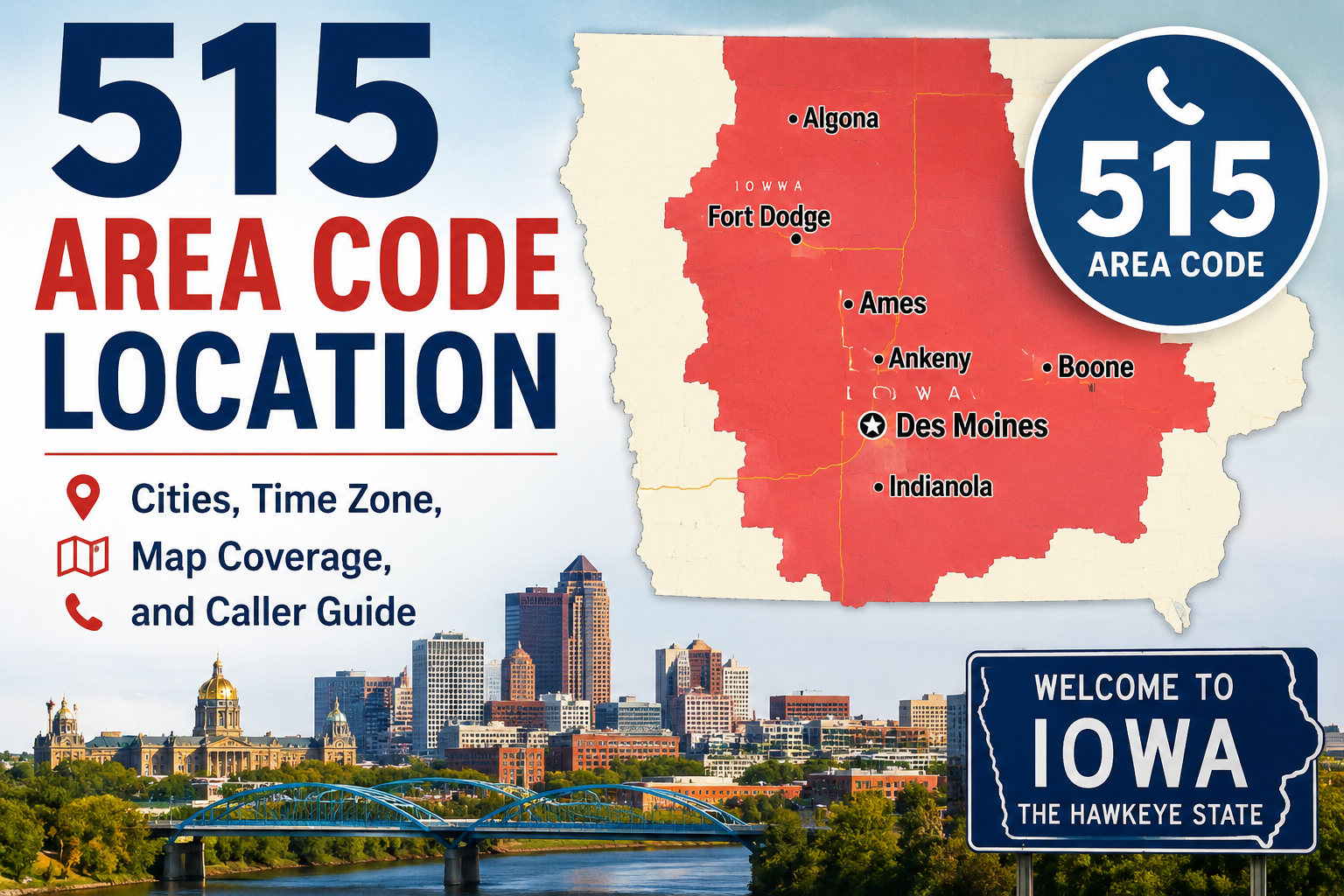
When you see a phone number beginning with 515, the quickest answer is that it is associated with central and north-central Iowa. The 515 area code location is centered on the Des Moines metropolitan area and also reaches important communities such as Ames, Ankeny, Fort Dodge, Boone, Indianola, and Algona.
It is a geographic code within the North American Numbering Plan, the system used to organize standard ten-digit telephone numbers across the United States and other participating countries.
That basic answer is useful, but it does not tell the whole story. A 515 number may belong to a resident, business, government office, university department, mobile subscriber, or internet-based phone service.
It also does not prove that the caller is physically in Iowa at the moment. This guide explains the coverage area, local time, dialing rules, history, business value, and the safest way to respond to an unfamiliar call.
Where Is the 515 Area Code Location?
The 515 area code location is in Iowa, primarily covering the Des Moines–Ames region and surrounding communities in the central and north-central part of the state. The largest and most recognizable city in the code is Des Moines, Iowa’s state capital.
The area generally extends northwest and north from the Des Moines metro. It includes a mix of urban centers, suburban communities, college towns, county seats, farming areas, and smaller rural exchanges.
Current area-code references commonly identify Des Moines, Ames, Ankeny, Fort Dodge, Humboldt, Boone, Jefferson, Johnston, Urbandale, Algona, and Indianola among the communities served.
Here is the practical summary:
- State: Iowa
- Primary region: Central and north-central Iowa
- Largest city: Des Moines
- Major metro: Des Moines–West Des Moines
- Notable additional cities: Ames, Ankeny, Fort Dodge, Boone, Indianola, Algona, and Humboldt
- Time zone: Central Time
- Country calling code: +1
The Iowa Utilities Commission maintains telecommunications service-territory information and exchange-boundary maps. These exchange maps are more detailed than a basic area-code map because local telephone exchange boundaries do not always follow city or county borders perfectly.
Which Cities Use the 515 Area Code Location?
The 515 area code location covers many of Iowa’s best-known central communities. Des Moines is the main population and business center, but the code is not limited to the capital.
Des Moines and Nearby Suburbs
The strongest concentration of 515 numbers is in and around Des Moines. Commonly served communities include:
- Des Moines
- West Des Moines
- Ankeny
- Urbandale
- Johnston
- Clive
- Altoona
- Grimes
- Polk City
- Bondurant
Official local and state-government directories regularly display 515 numbers, reflecting the code’s close association with the capital region.
For example, Iowa legislative directories use 515 for many state-office telephone contacts, while West Des Moines City Hall also publishes a 515 number.
Ames and Story County Communities
Ames is another major anchor within the 515 area code location. It is widely known as the home of Iowa State University and functions as a regional center for education, research, technology, agriculture, and employment.
Nearby 515 communities can include:
- Nevada
- Story City
- Huxley
- Gilbert
- Roland
- Cambridge
- Kelley
- McCallsburg
Coverage can vary at the edge of the numbering-plan area, so a city name alone should not be used to predict every individual telephone number.
Fort Dodge and Northern Communities
The code continues north and northwest to Fort Dodge and other communities. Common listings include Boone, Humboldt, Algona, Jefferson, and smaller towns connected to local telephone exchanges throughout the region.
This broad footprint explains why a 515 call may come from a large corporate office in Des Moines, a university department in Ames, a medical provider in Fort Dodge, or a family-owned business in a smaller Iowa community.
What Time Zone Is the 515 Area Code Location In?
The 515 area code location follows the Central Time Zone. It observes:
- Central Standard Time: UTC−6
- Central Daylight Time: UTC−5 during daylight-saving time
That matters when returning calls, scheduling interviews, contacting customer support, or coordinating business meetings.
Someone calling from New York is normally one hour ahead of the 515 region. Someone in Los Angeles is normally two hours behind it.
Because daylight-saving rules can differ internationally, overseas callers should check the current Iowa time rather than relying only on a fixed time difference. Current time-zone references list 515 under Central Time.
A reasonable calling window for a business is usually 9:00 a.m. to 5:00 p.m. Central Time, Monday through Friday. For personal numbers, avoid calling early in the morning or late in the evening unless the person has requested it.
Does a 515 Number Prove the Caller Is in Iowa?
No. The 515 area code location identifies where a number was originally assigned or geographically associated. It does not necessarily reveal where the phone or caller is currently located.
Mobile-number portability allows people to keep their telephone numbers after moving. Someone who opened a wireless account in Des Moines may later live in Texas, Florida, California, or another country while continuing to use the same 515 number.
Businesses can also use:
- Cloud-based telephone systems
- Internet-based calling services
- Remote employees
- Virtual business numbers
- Call-forwarding systems
- Centralized customer-support departments
Caller ID can also be manipulated. The FCC warns consumers about unwanted calls and caller-ID spoofing, including situations in which a displayed number is made to look local.
Treat the code as a geographic clue, not proof of identity or physical location.
Is a Call From the 515 Area Code Location a Scam?
A call from the 515 area code location is not automatically suspicious. Millions of legitimate personal, commercial, educational, healthcare, and government interactions use local Iowa telephone numbers.
However, scammers sometimes choose familiar-looking numbers because people are more likely to answer a call that appears local. The safest response depends on the caller’s message and behavior, not simply the area code.
Warning Signs to Watch For
Be cautious when a caller:
- Demands immediate payment.
- Requests gift cards, cryptocurrency, wire transfers, or cash.
- Claims you will be arrested unless you pay.
- Asks for a one-time password or account-verification code.
- Pressures you not to contact your bank, family, employer, or police.
- Requests your Social Security number or banking password.
- Asks for complete debit or credit card details.
- Refuses to provide a callback number, department, or written notice.
- Claims you have won a prize but must pay a fee first.
- Threatens to disconnect an essential service immediately.
A legitimate organization should allow you to end the call and verify the request independently.
Do not use a telephone number supplied by a suspicious caller. Find the organization’s official number through its verified website, account statement, bank card, government directory, or previous correspondence.
The FCC accepts complaints involving unwanted calls, texts, and suspected spoofing. It notes that complaint information supports enforcement and policy work, although the agency does not individually resolve every unwanted-call case.
How to Dial the 515 Area Code Location
The 515 area code location uses standard ten-digit dialing. For a domestic call, enter:
515 + seven-digit local number
For example:
515-555-0123
From outside the North American Numbering Plan, callers generally use:
+1 515 + seven-digit telephone number
The 515 region transitioned to mandatory ten-digit dialing in 2021 as part of the nationwide implementation of 988 as an easy-to-remember three-digit access number.
Iowa public notices explained that callers in 515 had to include the area code for local calls beginning October 24, 2021.
The change did not alter existing telephone numbers. It only changed how calls were dialed.
Residents and businesses also needed to update equipment and services that may have stored seven-digit numbers, including:
- Mobile contact lists
- Alarm systems
- Fax machines
- Medical-alert devices
- Call-forwarding settings
- Security systems
- Automatic dialers
- Office telephone systems
- Printed business materials
Emergency calls to 911 remain three-digit calls. The same principle applies to other designated three-digit services supported in the area.
History of the 515 Area Code Location
The 515 area code location has a long telecommunications history. The code was introduced as part of the original North American Numbering Plan in 1947.
Iowa initially had three principal area codes:
- 319
- 515
- 712
The original 515 territory covered a much larger section of Iowa than it does today.
Over time, demand for telephone numbers grew because of population changes, additional business lines, fax machines, pagers, mobile phones, and competitive telecommunications providers. By the end of the 1990s, relief planning was required.
In 2000, the 515 territory was divided and the new 641 code was created. NANPA’s official planning-letter archive records the “515 NPA Split, Creating New 641 NPA” in April 2000.
The split allowed the Des Moines–Ames region to retain 515 while many other central and southern Iowa communities moved to 641.
This history explains why older records may associate 515 with places that now use 641. When researching an old business, newspaper advertisement, family record, or historical directory, check the publication date before assuming that today’s area-code boundaries applied at that time.
What Counties Are Associated With the 515 Area Code Location?
The 515 area code location touches multiple counties, although area-code boundaries are based on telephone exchanges rather than simple county lines.
Frequently associated counties include:
- Polk County
- Story County
- Dallas County
- Boone County
- Webster County
- Humboldt County
- Kossuth County
- Greene County
- Hamilton County
- Wright County
- Parts of neighboring central and north-central counties
Polk County contains Des Moines and many of its suburbs. Story County includes Ames, while Webster County includes Fort Dodge.
Dallas County covers several fast-growing communities west of the Des Moines core, although cities and exchanges near area-code boundaries may use different codes.
For address-level accuracy, consult the telephone carrier, a current exchange map, or the number’s service information. A general city or county list is helpful for orientation, but it should not be treated as a legal or technical boundary description.
The Iowa Utilities Commission maintains exchange-area mapping as part of its telecommunications oversight resources.
Why the 515 Area Code Location Matters to Businesses
The 515 area code location has commercial value because it signals a connection to central Iowa. A local number can help a company appear accessible to customers in Des Moines, Ames, Ankeny, Fort Dodge, and nearby markets.
A local 515 number can be useful for:
- Home-service providers targeting central Iowa
- Medical and dental practices
- Law firms and accounting offices
- Real-estate agents
- Property-management companies
- Universities and training organizations
- Recruitment agencies
- Regional logistics providers
- Agriculture and manufacturing companies
- Restaurants and retailers
- Appointment-based businesses
- Remote companies building an Iowa presence
Still, a local number is not a substitute for a genuine local operation. Businesses should publish an accurate address, service area, opening hours, privacy policy, and customer-support information.
Misrepresenting a business location can damage consumer trust and may violate advertising or business-profile platform rules.
From a local SEO perspective, a 515 telephone number may reinforce location consistency when it matches the company’s verified central-Iowa address and other business citations.
The telephone number should be written consistently across:
- The company website
- Google Business Profile
- Social media pages
- Business directories
- Invoices
- Email signatures
- Customer communications
- Printed marketing materials
For example, a company should avoid publishing “515-123-4567” on one platform and an outdated number on another. Conflicting business information can confuse both customers and search engines.
How to Identify an Unknown 515 Caller
When an unfamiliar 515 number appears, use a calm verification process.
Step 1: Let the Call Go to Voicemail
Legitimate callers often leave their name, organization, reason for calling, and a callback number.
Fraudulent automated calls may leave vague threats, incomplete messages, or urgent instructions designed to create fear.
Step 2: Search the Complete Number
Search all ten digits in quotation marks. Compare results across:
- Official websites
- Verified business profiles
- Government directories
- University directories
- Credible public records
- Previous emails or account statements
Do not assume that the first reverse-lookup result is accurate. Some number databases contain outdated or user-submitted information.
Step 3: Verify the Organization Independently
If the caller claims to represent a bank, hospital, police department, school, utility provider, insurance company, or government agency, locate that organization’s official contact information yourself.
Call the verified number and ask whether the organization attempted to reach you.
Step 4: Examine the Message for Pressure Tactics
Urgency, secrecy, threats, unusual payment methods, and requests for authentication codes are major warning signs.
Legitimate organizations may have deadlines, but they should still provide a reasonable way to verify the request.
Step 5: Protect Your Personal Information
Never provide sensitive details merely because the caller knows your name, address, employer, or part of your account information.
Personal information can be obtained through data breaches, public records, social media, compromised accounts, and previous scams.
Step 6: Block and Report When Appropriate
Use your phone’s blocking tools and your carrier’s spam-reporting features. Serious fraud attempts can also be reported to relevant consumer-protection or law-enforcement authorities.
The 515 area code location can narrow the likely region, but safe identification requires matching the telephone number, organization, message, and context.
Common Misunderstandings About the 515 Area Code Location
Several assumptions repeatedly cause confusion.
“Every 515 Caller Is in Des Moines”
Des Moines is the main city, but the code also serves Ames, Ankeny, Fort Dodge, Boone, Algona, Indianola, Humboldt, Jefferson, and many smaller communities.
“A Local-Looking Number Is Safe”
Not necessarily. Caller ID can be spoofed, and mobile users can keep their numbers after moving.
“515 Covers All of Iowa”
It does not. Iowa also uses 319, 563, 641, and 712 for other parts of the state.
“You Can Still Dial Seven Digits Locally”
The region uses mandatory ten-digit dialing. Callers must normally include 515 even when dialing another local number.
“Area Codes Follow County Lines Exactly”
They do not. Telephone exchange boundaries can cross or divide counties and municipalities.
“All Reverse-Lookup Information Is Accurate”
Reverse-number databases can contain outdated names, previous owners, incorrect addresses, or crowdsourced labels. Important information should always be verified through an independent official source.
Conclusion
The 515 area code location is central and north-central Iowa, anchored by Des Moines and extending through Ames, Ankeny, Fort Dodge, Boone, Indianola, Algona, and surrounding communities.
It operates in the Central Time Zone and uses mandatory ten-digit dialing.
When you receive an unfamiliar 515 call, use the code as a starting clue rather than final proof. Check the complete number, listen to the voicemail, verify the organization through an independent source, and never provide sensitive information under pressure.
For businesses, a 515 number can support a genuine central-Iowa presence. However, lasting trust depends on accurate contact details, consistent business listings, transparent service information, and reliable customer support.
Frequently Asked Questions
1. What state is area code 515 located in?
The 515 area code location is in Iowa. It mainly serves the Des Moines–Ames region and other communities in central and north-central Iowa.
2. What major cities are in the 515 area code?
Within the 515 area code location, major cities and communities include Des Moines, Ames, Ankeny, West Des Moines, Urbandale, Johnston, Fort Dodge, Boone, Indianola, Algona, Humboldt, and Jefferson.
3. What time is it in the 515 area code?
The 515 area code location follows Central Time. It uses Central Standard Time in winter and Central Daylight Time during daylight-saving months.
4. Is 515 a legitimate area code or a scam code?
It is a legitimate geographic Iowa area code. However, scammers can spoof any telephone number, so the displayed code alone cannot confirm a caller’s identity.
5. Do I need to dial 515 for a local call?
Yes. Calls in the region require the full ten-digit telephone number, including 515, even when the call is local.
