


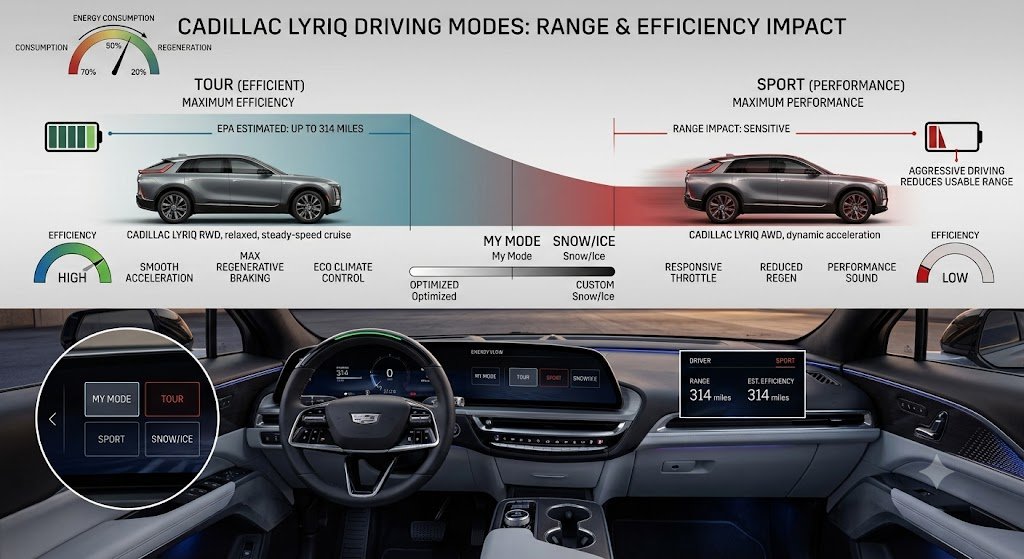
The question “do the driving modes in Cadillac LYRIQ offer different ranges or battery usages?” sounds simple, but the accurate answer depends on one important distinction: battery capacity and battery consumption are not the same thing.
Selecting Tour, Sport, Snow/Ice, or My Mode does not normally give the vehicle a different-sized battery or unlock a separate block of usable energy. What changes is how the LYRIQ responds to the driver.
Accelerator mapping, steering effort, traction behavior, suspension tuning, adaptive cruise response, electric-vehicle sound, and—on some versions—electric all-wheel-drive behavior may be adjusted.
That means Cadillac LYRIQ driving modes can change real-world battery usage, even though Cadillac does not publish a separate EPA range rating for every regular drive mode.
Quick Answer: Do Cadillac LYRIQ Driving Modes Change Range?
Yes, but mostly indirectly.
Tour is generally the most efficiency-friendly everyday setting. Sport can increase battery consumption when its sharper responses encourage stronger acceleration. Snow/Ice prioritizes traction and controlled torque delivery rather than maximum mileage. My Mode can be efficient or performance-focused, depending on how the driver configures it.
The 2025 LYRIQ owner’s manual lists Tour, Sport, Snow/Ice, and My Mode, while noting that availability and affected systems can vary by trim, region, optional equipment, and model year. It describes these settings as adjustments to several vehicle systems—not as changes to the battery’s physical capacity.
Therefore, when owners ask whether Cadillac LYRIQ driving modes offer different ranges, the clearest answer is:
- No separate fixed range is assigned to each normal mode.
- Yes, the selected mode can influence how quickly energy is consumed.
- Speed, driving style, temperature, climate use, tires, and vehicle configuration usually have a greater effect.
Do Cadillac LYRIQ Driving Modes Have Separate EPA Range Ratings?
No. EPA range is certified for a particular vehicle configuration, not for every selectable setting shown in the infotainment system.
For example, current Cadillac specifications list different estimated ranges for rear-wheel-drive and all-wheel-drive LYRIQ configurations. Those differences reflect the complete vehicle setup, including the number of motors, equipment, wheels, weight, and trim-related hardware. They should not be interpreted as a comparison between Tour and Sport modes.
This distinction prevents a common misunderstanding.
A dual-motor AWD LYRIQ may have a different official range from a single-motor RWD model because the hardware is different. Switching one vehicle from Tour to Sport does not transform it into another certified vehicle configuration.
In practical terms, Cadillac LYRIQ driving modes affect consumption patterns, not the official size of the energy tank.
How Cadillac LYRIQ Driving Modes Change Battery Usage
An electric vehicle uses energy according to the power demanded from its motors and supporting systems. A drive mode can influence that demand by changing how quickly the vehicle responds to the accelerator.
Imagine pressing the accelerator 25% of the way down.
In Tour, that input may produce a smooth, progressive response. In Sport, the same pedal movement may feel more immediate. The car is not necessarily wasting electricity merely because Sport is active, but its sharper response makes it easier to request more torque.
The effect becomes more noticeable during:
- Repeated hard acceleration
- High-speed highway driving
- Aggressive corner exits
- Frequent slowing and re-acceleration
- Slippery conditions requiring active traction management
- Performance driving in a dual-motor or LYRIQ-V model
At a steady speed on a flat road, the difference between modes may be relatively small. Aerodynamic resistance, tire friction, wind, elevation changes, and climate-control demand can dominate the energy calculation.
That is why Cadillac LYRIQ driving modes should be viewed as response calibrations rather than simple “high-range” and “low-range” buttons.
Does Tour Mode Provide the Best Cadillac LYRIQ Range?
For normal commuting, Tour is the best starting point for efficient driving.
Cadillac describes Tour as the setting for everyday city and highway driving, balancing comfort and handling. Cadillac’s general driver-mode guidance also identifies Tour or Normal as the most economical everyday selection.
Tour can support better efficiency because it encourages smoother accelerator inputs. Gentle acceleration reduces sudden power demands, while predictable response makes it easier to maintain a steady speed.
Tour is particularly suitable for:
- Daily commuting
- Urban and suburban journeys
- Long highway travel
- Consistent energy consumption
- Smooth passenger comfort
- Predictable accelerator response
However, Tour is not a magic range-extending mode.
A driver cruising at 80 mph in Tour may consume more electricity than a careful driver traveling at 60 mph in Sport. At highway speeds, aerodynamic resistance can matter considerably more than the selected drive mode.
Among the regular Cadillac LYRIQ driving modes, Tour is the most sensible baseline for measuring the vehicle’s normal efficiency.
Does Sport Mode Use More Battery?
Sport mode can use more battery, but it does not automatically drain the battery at a permanently higher rate.
According to the LYRIQ owner’s manual, Sport can modify accelerator tuning, steering effort, electric-vehicle sound enhancement, adaptive cruise behavior, and suspension tuning where equipped. Cadillac intends it to improve handling and acceleration response on dry pavement.
The main efficiency penalty comes from what the driver does with that sharper response.
Sport mode is more likely to increase consumption when you:
- Accelerate hard from traffic lights.
- Use more speed between corners.
- Brake late and accelerate again.
- Make frequent high-torque passing maneuvers.
- Travel faster because the vehicle feels more responsive.
- Repeatedly exploit the instant torque of the electric motors.
Electric motors can deliver substantial torque almost immediately. Requesting that performance repeatedly requires significant power from the battery.
However, activating Sport does not mean maximum power is being consumed continuously. If you maintain a calm, steady pace, the efficiency difference may be modest.
The laws of physics still determine most of the energy required to move the vehicle.
Therefore, the answer to “do the driving modes in Cadillac LYRIQ offer different ranges or battery usages?” is not that Sport receives a smaller battery. Sport simply gives the driver more opportunities to use energy quickly.
Does Snow/Ice Mode Reduce Range?
Snow/Ice is a traction setting, not an economy mode.
Cadillac says the mode adjusts accelerator response to optimize traction on slippery surfaces. On equipped models, it can also modify electric AWD behavior and steering. The owner’s manual warns that Snow/Ice may compromise acceleration on dry asphalt because it is specifically calibrated for snow-covered or low-grip roads.
The gentler torque response may prevent unnecessary wheelspin. That can reduce wasted energy while also improving control.
However, winter conditions themselves frequently cause a larger range reduction than the selected mode.
Cold-weather energy losses can come from:
- Battery heating and thermal management
- Cabin heating
- Cold-soaked battery cells
- Lower tire pressure
- Denser outside air
- Snow and slush resistance
- Winter tires with higher rolling resistance
- Reduced regenerative-braking availability in certain conditions
Cadillac’s energy-efficiency guidance states that colder temperatures increase energy use and reduce EV driving range. It also identifies speed, elevation changes, and climate-control use as significant factors.
Therefore, among Cadillac LYRIQ driving modes, Snow/Ice may feel more restrained, but it does not guarantee lower battery consumption than Tour in mild weather.
Choose Snow/Ice because the road is slippery—not because you are trying to add a few miles to the range estimate.
Can My Mode Improve Battery Efficiency?
My Mode allows the driver to create a personalized combination of settings.
Depending on the vehicle’s equipment, customization may include:
- Accelerator feel
- Brake feel
- Steering response
- Suspension behavior
- Electric motor sound
The owner’s manual notes that My Mode can remain active after the vehicle is turned off and restarted.
A range-focused My Mode would normally use:
- Relaxed or Tour-style accelerator response
- Smooth braking characteristics
- Comfortable steering
- Moderate regenerative braking
- A driving style that avoids unnecessary acceleration
A performance-focused My Mode might combine Sport accelerator response, heavier steering, firmer suspension, and more aggressive driving.
The My Mode label alone does not indicate whether the vehicle will be efficient.
Among Cadillac LYRIQ driving modes, My Mode is the most dependent on the driver’s saved settings and behavior.
Is One-Pedal Driving Part of the Drive Mode?
Not exactly.
One-Pedal Driving is a separate deceleration and regenerative-braking setting, although Cadillac may provide quick access to it through the Drive Mode application or controls tray.
The LYRIQ offers three One-Pedal Driving selections:
- Off
- Normal
- High
When operating conditions permit, the system uses regenerative braking to slow the vehicle and return some recovered energy to the battery.
Regeneration is most valuable when slowing down is unavoidable. In urban traffic, it can recover energy that conventional friction brakes would otherwise convert into heat.
However, stronger regeneration does not always mean better efficiency.
Suppose you accelerate to 50 mph, use High One-Pedal Driving to slow to 30 mph, and then accelerate back to 50 mph. Some energy will be recovered during deceleration, but not all of it. Every energy conversion involves losses.
When the road is open, maintaining momentum or gently coasting may be more efficient than repeatedly accelerating and regenerating.
Cadillac also recommends turning One-Pedal Driving off on slippery roads. Predictable traction and safe vehicle control should take priority over recovering additional energy.
When comparing Cadillac LYRIQ driving modes, keep the One-Pedal Driving level consistent. Otherwise, you may attribute a change to Tour or Sport when the real difference came from regenerative-braking settings.
Which Factors Affect LYRIQ Range More Than Drive Mode?
The selected mode matters, but several variables usually have a greater effect.
Vehicle Speed
Higher speeds increase aerodynamic resistance substantially.
A modest reduction in sustained highway speed can save more energy than changing from Sport to Tour while continuing to travel quickly.
This is also why highway range can fall even when the accelerator feels steady. The motors must continuously overcome air resistance.
Temperature and Climate Control
Heating and air conditioning draw power from the high-voltage battery.
Preconditioning while the LYRIQ is connected to a charger can warm or cool the cabin before departure without relying entirely on stored driving energy.
In winter, heated seats may use less energy than aggressively heating the entire cabin, although comfort and visibility should always come first.
Acceleration and Braking Habits
Rapid acceleration requires large amounts of power.
Smooth acceleration, early anticipation, and fewer unnecessary speed changes usually improve efficiency in every mode.
Elevation and Wind
Driving uphill consumes significant energy. A downhill section may recover some of it, but regeneration cannot return every unit of energy used during the climb.
A strong headwind can also lower range noticeably, even on a familiar route.
Tires and Wheels
Battery efficiency can be affected by:
- Low tire pressure
- Larger wheels
- Winter tires
- Aggressive tire tread
- Poor wheel alignment
- Increased rolling resistance
A tire-related change may be mistakenly blamed on the selected drive mode.
Payload, Towing, and Exterior Accessories
Heavy cargo, towing, roof boxes, bicycle carriers, and exterior racks increase the amount of energy required to move the vehicle.
These variables explain why two owners using the same Cadillac LYRIQ driving modes may report very different consumption figures.
Do LYRIQ-V Driving Modes Consume More Battery?
The LYRIQ-V needs separate consideration because it provides much greater performance capability.
Cadillac states that the 2026 LYRIQ-V uses a 102-kWh battery pack and has an EPA-estimated range of 285 miles. Velocity Max enables Cadillac-estimated output of up to 615 horsepower and 650 lb-ft of torque. V-Mode, Competitive Mode, and Launch Control provide additional performance functions.
Using that performance can consume energy rapidly.
Repeated launches, full-throttle acceleration, high-speed driving, and aggressive corner exits will reduce the remaining range faster than relaxed cruising.
Still, activating V-Mode does not mean the motors constantly draw maximum power. The additional output is available when requested. Battery consumption continues to follow the driver’s actual power demand.
The LYRIQ-V’s lower official range reflects the complete performance vehicle, including:
- Dual electric motors
- Performance wheels and tires
- Vehicle weight
- Chassis tuning
- Aerodynamic characteristics
- Available power
- Supporting performance hardware
It is not caused solely by the presence of a performance-mode button.
Even so, performance-focused Cadillac LYRIQ driving modes can create a more noticeable real-world difference because they provide access to substantially greater output.
How to Test Battery Usage Between Cadillac LYRIQ Driving Modes
A single commute is not enough to make a fair comparison. Traffic, temperature, wind, elevation, and battery conditioning can distort the result.
Use this controlled testing method:
- Choose the same 20- to 30-mile route.
- Begin each test at a similar battery percentage.
- Use the same climate temperature and fan setting.
- Keep passengers and cargo consistent.
- Check that tire pressure is unchanged.
- Drive the route several times in Tour.
- Repeat the route in Sport or My Mode.
- Use the same One-Pedal Driving level.
- Maintain similar speeds and acceleration.
- Compare average efficiency rather than the estimated remaining miles.
Discard trips affected by unusual congestion, heavy rain, strong wind, or extreme temperature changes.
The LYRIQ’s Energy Usage screen can separate driving energy from cabin climate, remote climate, and fast-charge battery preparation. Its Energy Efficiency display can show recent efficiency, regeneration, and average performance. These measurements are more useful than judging a mode from one fluctuating mileage estimate.
The remaining-range display is a forecast. It can adjust according to recent driving and operating conditions.
This testing process gives owners a personal, repeatable answer about Cadillac LYRIQ driving modes based on their roads, climate, and driving habits.
Best Cadillac LYRIQ Mode for Each Driving Situation
| Driving situation | Recommended mode | Battery-use guidance |
|---|---|---|
| Daily commuting | Tour | Best everyday efficiency baseline |
| Long highway journey | Tour | Speed and wind matter more than mode |
| Spirited dry-road driving | Sport | Consumption rises when sharper performance is used |
| Snow or ice | Snow/Ice | Prioritize traction and safety |
| Personalized commuting | My Mode | Choose relaxed accelerator tuning for efficiency |
| LYRIQ-V performance driving | V-Mode or Velocity Max | Maximum output can consume energy quickly |
| Slippery surfaces | Snow/Ice | Follow Cadillac’s One-Pedal Driving safety guidance |
The best setting is the one suited to the road.
Cadillac LYRIQ driving modes are designed to adapt the vehicle’s behavior. They are not intended to replace safe driving or sensible energy management.
How to Extend Cadillac LYRIQ Range in Any Mode
The following habits normally provide a more reliable improvement than repeatedly switching drive modes:
- Accelerate progressively.
- Maintain a moderate highway speed.
- Anticipate stops instead of braking late.
- Precondition the vehicle while plugged in.
- Use seat heating thoughtfully instead of heavily heating the entire cabin.
- Keep tires at the recommended pressure.
- Remove unused roof racks and unnecessary cargo.
- Plan routes around temperature, elevation, and charging access.
- Prepare the battery before arriving at a compatible DC fast charger.
- Monitor average miles per kilowatt-hour over complete trips.
- Use Tour as your normal efficiency benchmark.
- Avoid judging efficiency from a very short journey.
Cadillac also recommends an 80% target charge for routine daily driving, with a higher target available when longer trips require additional range.
Conclusion: Do the Driving Modes in Cadillac LYRIQ Offer Different Ranges or Battery Usages?
Cadillac LYRIQ driving modes can produce different real-world battery usage, but they do not normally provide separate battery capacities or fixed EPA range figures.
Tour is the strongest everyday choice for smooth, efficient driving. Sport may consume more energy when its sharper response leads to harder acceleration. Snow/Ice adjusts the vehicle for slippery conditions, while My Mode can be efficient or aggressive depending on its configuration.
On the LYRIQ-V, performance settings such as Velocity Max can consume energy especially quickly when the additional output is fully used.
The most useful approach is straightforward:
Use Tour as your efficiency baseline, select Snow/Ice when road conditions require it, reserve performance settings for appropriate situations, and compare average energy consumption over repeated journeys.
The selected mode matters. Your speed, accelerator use, weather, tires, climate settings, and route will usually matter more.
Frequently Asked Questions
1. Does Sport mode permanently lower Cadillac LYRIQ range?
No. Sport mode does not permanently reduce battery capacity.
It changes accelerator response and other vehicle characteristics. Battery usage rises mainly when the driver takes advantage of the sharper acceleration, higher speed, or more aggressive handling.
Switching back to Tour and driving smoothly allows efficiency to return to a level determined by current conditions.
2. Is Tour mode the LYRIQ’s Eco mode?
Cadillac calls the setting Tour rather than Eco.
However, Tour is the normal everyday mode and the most economical general-purpose choice. It provides a balanced response suitable for routine city and highway driving.
3. Can Snow/Ice mode save energy by reducing wheelspin?
It may prevent some energy from being wasted through wheelspin, but Snow/Ice is designed primarily for traction.
Cold temperatures, cabin heating, snow, slush, winter tires, and lower tire pressure may outweigh any efficiency benefit created by the gentler accelerator response.
4. Does High One-Pedal Driving always increase range?
No.
High One-Pedal Driving can recover energy when deceleration is necessary, especially in urban traffic. However, smooth coasting can be more efficient when slowing is unnecessary.
Cadillac also recommends disabling One-Pedal Driving on slippery roads.
5. Do the driving modes in Cadillac LYRIQ offer different ranges or battery usages on the LYRIQ-V?
They can create more noticeable differences because the LYRIQ-V’s performance settings provide access to much higher power.
Velocity Max, Launch Control, and aggressive V-Mode driving can use battery energy quickly. However, the 285-mile EPA estimate applies to the complete vehicle configuration—not separately to each individual performance mode.
