


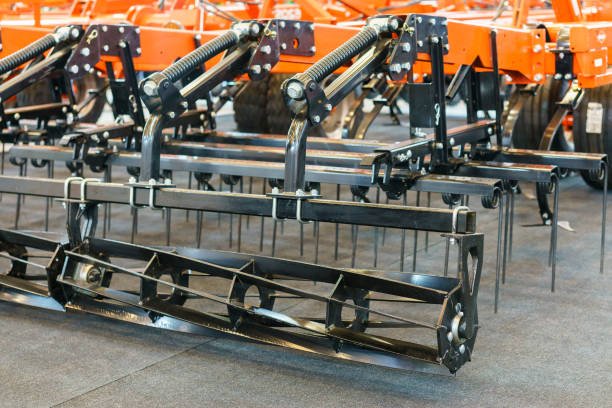
A Messeregge is a German agricultural implement used to break clods, level the soil surface, and support seedbed preparation. The name combines Messer, meaning knife or blade, with Egge, meaning harrow.
That definition matters because online explanations increasingly mislabel the term as a digital platform, regional dish, or vague cultural concept. In documented agricultural usage, it describes a blade-equipped harrow or blade-harrow attachment, often fitted ahead of a front packer.
This guide separates verified machinery facts from recycled speculation. It explains how the implement works, where it performs well, what it cannot do, and how to assess one before purchase.
What Is a Messeregge? The Verified Meaning
The simplest English translation is knife harrow or blade harrow.
German dictionary definitions describe an Egge as an agricultural device used for shallow loosening, crumbling, and weed control. The word Messer can also describe a hardened steel blade or cutting plate used in machinery. Put together, the compound name describes the tool’s construction rather than a particular brand or proprietary technology.
A Messeregge normally consists of a rigid frame carrying multiple steel blades. These blades contact the upper soil layer as the tractor moves forward.
Depending on the machine, the attachment may be:
- Mounted in front of a packer roller
- Incorporated into a combined seedbed cultivator
- Offered as an interchangeable front-working tool
- Adjusted mechanically through spindles
- Controlled hydraulically on more advanced models
Kerner’s current TORON front-packer documentation, for example, lists the knife harrow alongside a spring-tine harrow and crossboard. The manufacturer identifies its primary job as breaking clods and soil slabs, with working depth adjusted mechanically by a spindle or, optionally, hydraulically.
The practical definition is therefore clear: a shallow-working, blade-based soil-finishing tool designed to improve surface structure before sowing or another cultivation pass.
How a Messeregge Works Without Deeply Inverting Soil
The operating principle is straightforward.
Fixed blades enter the top layer of the field and are pulled forward rather than rolled through the soil. Their leading edges strike, split, and crumble larger clods. The frame distributes that action across the machine’s entire working width.
The finished result depends on four interacting variables.
- Working depth: Deeper engagement increases resistance and aggressiveness.
- Blade angle: A more direct angle normally increases the breaking effect.
- Forward speed: Speed changes impact energy, soil movement, and finishing quality.
- Soil moisture: Moisture determines whether clods fracture, smear, or stick to the implement.
A Messeregge is frequently paired with a front packer because the two components perform different jobs within one pass.
The blades create a pulling, cutting, and leveling action. The roller then provides additional crumbling, depth guidance, and reconsolidation. Kerner describes this combined approach as integrating crumbling, leveling, and reconsolidation in one machine.
The implement should not be confused with hardened knives mounted between certain packer rings.
Those internal knives can help break soil and keep roller segments clear, but they remain part of the roller assembly. The separate blade harrow is a front-mounted working tool with its own frame and depth adjustment. Kerner’s operating manual distinguishes between the cutting tools located inside the roller and the knife or spring-tine harrow mounted at the front.
Where a Messeregge Delivers the Best Results
The tool is most valuable when the field has already received primary cultivation but still has an uneven, cloddy surface.
It should generally be considered a finishing implement rather than a replacement for every type of tillage equipment.
Typical applications include:
- Breaking clods after ploughing or deeper cultivation
- Refining a rough surface before drilling
- Leveling shallow ridges and tractor marks
- Supporting a combined front-and-rear seedbed pass
- Preparing medium or heavier soils when clods are dry enough to fracture
- Improving the consistency of the layer in which seed will be placed
A correctly configured Messeregge can sometimes reduce the need for an additional leveling pass. That benefit, however, depends on field conditions and the implement being operated behind the tractor.
The complete cultivation system should always be evaluated. Assessing the attachment in isolation can produce misleading conclusions.
The best setup is usually the one that creates a stable, even seedbed without overworking the soil. Excessive cultivation can pulverize dry ground, accelerate moisture loss, and leave fine particles vulnerable to crusting or erosion.
The objective is not to create the finest possible surface. It is to establish a workable balance between:
- Clod breakdown
- Surface leveling
- Moisture retention
- Pore structure
- Reconsolidation
- Seed-placement consistency
When a Messeregge Is the Wrong Tool
No agricultural implement performs equally well in every condition.
A blade harrow can disappoint when buyers expect it to behave like a disc cultivator, deep-tine machine, residue chopper, or subsoiler.
Avoid treating it as the primary solution in the following situations.
1. Heavy residue must be chopped and mixed
Fixed blades can catch or bunch long plant material instead of processing it evenly. A disc-based cultivator, knife roller, or purpose-built residue-management implement may be more suitable.
2. Deep compaction must be removed
The attachment works near the surface. It cannot replace a subsoiler, ripper, or deep cultivator when compacted layers exist below the seedbed.
3. Wet clay is plastic and sticky
Wet soil may smear, drag, and accumulate on the blades instead of fracturing. Working such soil aggressively can damage structure rather than improve it.
4. Large stones dominate the field
Repeated impact against stones can accelerate blade wear, loosen fasteners, bend mountings, or damage sections of the supporting frame.
5. Established weeds require complete root severance
Blade arrangement and spacing may leave untreated strips. Performance depends on whether the cutting elements overlap across the full working width.
This is why field demonstrations matter.
Soil texture, moisture, residue volume, tractor balance, forward speed, and the rear-mounted implement can change performance dramatically. A configuration that leaves an excellent finish on one farm may be too aggressive, too shallow, or too prone to blockage on another.
Messeregge vs. Other Seedbed Tools
Selecting the correct implement requires understanding what each alternative is designed to accomplish.
Messeregge vs. Spring-Tine Harrow
A spring-tine harrow uses flexible tines that vibrate and move around obstacles. It can be effective for crumbling, leveling, and distributing organic material.
Kerner specifically lists leveling and organic-matter distribution among the functions of its spring-tine version. Its knife-harrow description focuses more directly on breaking clods and soil slabs.
Choose the blade version when direct clod impact is the primary objective.
Choose spring tines when flexibility, residue flow, and raking action are more important.
Messeregge vs. Crossboard
A crossboard is primarily a leveling device.
Its paddles or bars move material from high spots into low areas. The working angle can normally be adjusted to increase or decrease aggressiveness.
A crossboard can crush some clods, but its defining function is broad surface leveling. A Messeregge uses individual blades to concentrate force at multiple points and may therefore provide a more targeted clod-breaking action.
Messeregge vs. Disc Harrow
A disc harrow uses rotating, usually concave discs to cut, lift, and mix soil and residue.
It generally creates more soil movement and often performs better where larger volumes of residue must be incorporated. That increased action may also require greater draft and produce more soil disturbance.
The blade harrow is usually shallower and mechanically simpler. It is better suited to finishing work where deep mixing or inversion is not the main objective.
Messeregge vs. Knife Roller
A knife roller has blades arranged around a rotating cylinder or drum. It is generally intended to crush or cut vegetation and crop residues.
Despite the shared word “knife,” the mechanisms are different.
The knife harrow drags fixed blades through the upper soil layer. The knife roller rotates and repeatedly strikes the material beneath it.
The two terms should not be used interchangeably when comparing machinery, performance, or replacement parts.
How to Set a Messeregge for an Even Finish
Correct adjustment is more important than maximum aggressiveness.
Begin conservatively and change one variable at a time. This allows the operator to identify which adjustment actually improves or damages the result.
1. Level the carrier machine
The frame must run horizontally across the field.
Kerner’s operating manual states that its front packer should be aligned level through the tractor’s top link. This alignment helps the front-working tools maintain a consistent depth across the field.
When the frame tips forward, the blades may bite too aggressively.
When it tips backward, they may skim across the surface and leave larger clods untreated.
2. Match both sides precisely
Mechanical depth systems often use separate adjustment spindles on each support frame.
Measure those settings rather than relying on appearance. The manufacturer’s operating instructions require the spindle settings to be equal and all sections of folding machines to maintain the same working depth.
Unequal adjustment can produce:
- Ridges between sections
- Uneven draft loads
- Variable working depth
- Inconsistent seedbed structure
- Accelerated blade wear on one side
3. Begin with shallow engagement
Set the Messeregge only deep enough to engage the clods that require treatment.
A deeper setting is not automatically more effective. It increases draft, moves more soil, accelerates wear, and can bring wetter material to the surface.
The current TORON brochure lists an adjustable working-depth range of 0–10 centimetres for its front-tool configurations. That is a model-specific specification rather than a universal working-depth recommendation.
The same documentation lists 2.5, 3, and 3.5-metre working widths and identifies “ME” as the knife-harrow configuration.
4. Test at normal operating speed
Drive a short test strip at the speed expected during regular fieldwork.
Stop the tractor, lower the machine safely, and inspect the soil profile. Do not judge the result only from the cab.
Check whether:
- Large clods are fractured rather than pushed aside
- The surface is level across the full working width
- Wet soil is smearing behind the blades
- Residue passes through without bunching
- The packer reconsolidates the soil evenly
- The following implement receives a consistent surface
- Wheel tracks remain visible after the pass
5. Recheck whenever conditions change
Morning moisture, shaded field edges, different soil zones, and headland traffic can all change how the attachment behaves.
A setting that works in the centre of a dry field may fail on a wetter headland. Adjust the tool whenever soil texture, moisture, residue, or compaction changes.
A single fixed setting for an entire farm is rarely the most effective approach.
Maintenance That Protects Performance and Resale Value
A Messeregge has fewer moving parts than many powered implements, but neglect still affects finishing quality, reliability, and structural life.
Build routine maintenance around the following checks:
- Inspect blades for uneven wear, cracks, bending, and missing fasteners.
- Tighten frame, bracket, and blade bolts at the recommended intervals.
- Lubricate pivots and adjustment mechanisms where required.
- Keep spindle threads clean and protected from corrosion.
- Examine welds and frame sections after significant stone impacts.
- Replace badly worn blades before working depth becomes uneven.
- Check hydraulic hoses, cylinders, and connections on adjustable models.
- Lower and secure the machine before performing maintenance.
- Release stored hydraulic pressure before disconnecting components.
Kerner’s front-packer manual calls for fastening bolts to be checked after initial operation, grease points to be lubricated during use, and hydraulic or structural repairs to be completed by competent personnel.
Those instructions apply specifically to the manufacturer’s machine, but they illustrate the maintenance discipline buyers should confirm in the manual for their own model.
Spare-part identification deserves particular attention.
Equipment catalogues may distinguish between left, right, and straight blades. Visual similarity does not guarantee compatibility. Kerner’s parts documentation, for example, lists separate part numbers for all three blade positions.
Before ordering replacement components, record:
- Manufacturer
- Model designation
- Serial number
- Blade position
- Blade dimensions
- Hole spacing
- Material thickness
- Original part number
- Required bolt specification
How to Buy the Right Messeregge
Buying based on working width and price alone is risky.
The attachment must suit the tractor, carrier machine, soil conditions, transport requirements, and intended cultivation sequence.
Ask the seller to confirm:
- The exact manufacturer and model compatibility
- Working width and legal transport width
- Three-point or carrier attachment category
- Total weight and effect on front-axle loading
- Blade count, arrangement, spacing, and dimensions
- Replacement-blade availability and cost
- Mechanical or hydraulic depth adjustment
- Minimum hydraulic requirements
- Evidence of bent sections, repairs, or cracked welds
- Availability of an operator’s manual and parts diagram
- Compatibility with the intended front packer
- Whether a field demonstration is available
Current specifications demonstrate why model-level verification is essential.
Kerner’s TORON documentation lists 24 knife-harrow elements, 125-millimetre line spacing, Category II attachment, and a weight of 200 kilograms for the knife-harrow option. Those figures apply to that particular configuration and should not be assumed for another make, model, or manufacturing generation.
When inspecting a used Messeregge, compare blade wear across the entire working width.
Heavy wear in the centre section or tractor wheel tracks can reveal:
- Uneven previous adjustment
- Incorrect tractor linkage setup
- Excessive working depth
- Frequent operation in abrasive soil
- A large number of operating hours
Test every adjustment mechanism as well.
A seized spindle, damaged hydraulic cylinder, bent carrier bracket, or obsolete blade design can turn an apparently inexpensive purchase into a costly workshop project.
Common Myths and Search Confusion
The term has recently attracted webpages that assign it unrelated meanings.
Some describe it as software, a communication platform, a regional food, a cultural location, or an abstract philosophy. Such descriptions are not supported by the agricultural manufacturer manuals, machinery catalogues, spare-parts documents, and equipment listings in which the word is demonstrably used.
Three checks can quickly expose an unreliable explanation:
- Does the page show an actual agricultural machine or technical drawing?
- Does it cite a manufacturer, operating manual, or parts catalogue?
- Does it discuss blades, frames, depth adjustment, working width, or soil conditions?
When none of those elements appears, the definition is likely speculative or fabricated.
Reliable information should connect the term to documented agricultural equipment. It should also distinguish universal operating principles from specifications that apply only to one manufacturer or model.
Conclusion: Treat the Messeregge as a Precision Finishing Tool
A Messeregge is best understood as a knife or blade harrow used for shallow soil preparation.
Its value lies in controlled clod breaking and surface refinement, particularly when combined with a front packer or another seedbed implement.
The actionable approach is straightforward:
- Verify machine and tractor compatibility.
- Set the supporting frame level.
- Begin with shallow blade engagement.
- Test the result in the soil rather than judging it from the cab.
- Adjust the machine whenever field conditions change.
- Maintain the blades, fasteners, and depth-control system carefully.
Do not purchase it as a universal tillage solution. Select it when the soil conditions and cultivation sequence genuinely require direct, blade-based finishing action.
A well-chosen and correctly adjusted blade harrow can make a cultivation pass more consistent. A poorly matched attachment merely adds weight, draft, wear, and complexity.
The difference comes from evidence-based selection, careful field testing, and disciplined setup.
Frequently Asked Questions About Messeregge
1. What does Messeregge mean in English?
It most directly means knife harrow or blade harrow.
The German component Messer means a knife or technical cutting blade, while Egge refers to an agricultural harrow used for shallow soil working, crumbling, and leveling.
The term therefore describes the machine’s blade-based construction and agricultural function.
2. Is a Messeregge the same as a knife roller?
No.
A knife harrow uses fixed blades that are pulled through the upper soil layer. A knife roller uses blades mounted around a rotating drum and is commonly selected to crush or cut vegetation and crop residue.
Their working actions, primary applications, adjustment systems, and replacement parts are different.
3. How deep should a Messeregge work?
There is no universal working depth.
The attachment should be set only deep enough to fracture the target clods and produce an even surface. Excessive depth increases draft, wear, and soil movement without necessarily improving the seedbed.
One current Kerner system provides an adjustment range of 0–10 centimetres, but soil moisture, machine geometry, blade wear, forward speed, and the following implement determine the appropriate field setting.
4. Can a Messeregge work in wet soil?
It can operate in certain moist conditions, especially when combined with a well-designed packer and clearing system.
However, plastic or sticky soil may smear, accumulate around the blades, or move as large slabs instead of crumbling. Manufacturer literature notes that integrated cutting and clearing systems can support operation in moist conditions, but that does not mean every knife-harrow configuration will remain blockage-free in wet clay.
A short field test is the safest way to determine whether conditions are suitable.
5. What should I inspect when buying a used Messeregge?
Inspect the frame for bending, weld repairs, corrosion, and impact damage. Compare blade wear across the entire width and check whether the correct left, right, and straight blade types are installed.
Also examine:
- Adjustment spindles
- Hydraulic hoses and cylinders
- Pivot points
- Blade fasteners
- Attachment brackets
- Transport locks
- Model identification plates
- Replacement-parts availability
Request the serial number, operating manual, and original parts diagram before completing the purchase.
