


Vitilinox is a commercial name associated with products and online information marketed to people living with vitiligo. Public descriptions present it as a natural formula intended to support melanocytes, protect the skin from oxidative stress, improve hydration, and encourage a more even skin tone. However, the available product information is inconsistent, and there is currently an important difference between the claims made about Vitilinox and the level of clinical evidence available for the complete formula.
The Vitilinox website refers to the product as a supplement in some places and as a topical skin-support product or oral formula in others. It also promotes claims such as “clinically formulated,” “dermatologist approved,” “clinically tested,” and “no side effects,” while acknowledging elsewhere that the combined formula has not undergone large-scale independent clinical trials. These inconsistencies mean that anyone considering the product should examine the exact label, manufacturer, ingredients, dosage, safety warnings, and formulation rather than relying only on general website descriptions.
This article explains what Vitilinox appears to be, how its proposed ingredients relate to vitiligo research, what the evidence can and cannot show, which safety issues are commonly overlooked, and how it compares with established medical treatments.
Medical disclaimer: This information is educational and is not a diagnosis or treatment recommendation. Vitiligo and unexplained loss of skin pigment should be assessed by a qualified dermatologist.
What Is Vitilinox?
Vitilinox appears to be a commercial vitiligo-support product or product concept rather than a recognized generic medicine. Its public-facing website describes it as a formula intended to support pigment-producing cells, reduce the appearance of white patches, protect against oxidative stress, and improve the condition of vitiligo-affected skin.
The exact product identity is not completely clear. The website’s main promotional section describes Vitilinox as a supplement, while another section states that it may be a topical product and, in some formulations, an oral supplement. It also says that the ingredient profile can vary across brands. Therefore, the name Vitilinox should not be treated as if it refers to one universally standardized formula.
This distinction matters because a cream, capsule, herbal oil, vitamin supplement, and cosmetic moisturizer have different absorption patterns, risks, labeling requirements, and evidence standards. Two products carrying similar names may contain different active ingredients or concentrations.
Before buying or using Vitilinox, consumers should confirm whether the specific product is:
A topical cream, oil, serum, or lotion
An oral capsule, tablet, powder, or liquid
A cosmetic moisturizer marketed for depigmented skin
A dietary supplement containing herbs, vitamins, or minerals
A combination product intended for both internal and external use
The complete ingredient list and dosage instructions are more important than the product name alone.
How Is Vitilinox Marketed to Work?
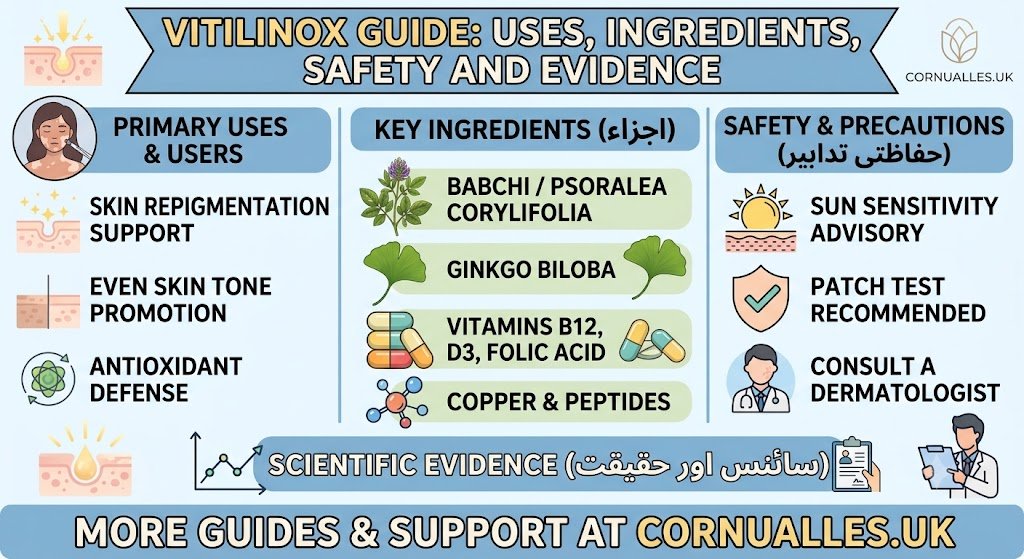
The main marketing explanation for Vitilinox focuses on three areas: antioxidant protection, skin-barrier support, and melanocyte support.
Melanocytes are the cells that produce melanin, the pigment that contributes to the color of the skin, hair, and eyes. In vitiligo, these cells are damaged or destroyed, largely through an autoimmune process in which the immune system mistakenly attacks the body’s own pigment-producing cells.
The Vitilinox website suggests that antioxidants may help protect melanocytes from damage caused by oxidative stress. Oxidative stress is being studied as one part of vitiligo development, and some research supports a possible role for antioxidant supplements as an addition to standard care. However, researchers have also emphasized that confirmatory studies are still needed. Antioxidants alone do not necessarily stop the immune mechanisms responsible for melanocyte destruction.
The product is also promoted as supporting skin hydration and the skin barrier. Moisturizing ingredients may reduce dryness, tightness, or irritation, but improved hydration should not be confused with repigmentation. A moisturizer can make skin feel healthier without restoring melanocytes or altering the underlying autoimmune process.
Understanding Vitiligo Before Evaluating Vitilinox
Vitiligo is a chronic autoimmune condition that causes areas of skin to lose pigment. It can affect any skin type, although the contrast may be more noticeable in people with darker skin. Vitiligo is not contagious, and it is not caused by poor hygiene or an infection.
Common signs include smooth white or milky patches, premature whitening of scalp or facial hair, and pigment loss inside the mouth or nose. Generalized or nonsegmental vitiligo often affects both sides of the body, while segmental vitiligo commonly develops on one side and may follow a different progression pattern.
The course of the condition is unpredictable. Some patches remain stable, some spread gradually, and others may progress rapidly. Treatment can sometimes restore color, slow progression, or stabilize the condition, but no treatment produces the same result for every person. Repigmentation can also be incomplete or temporary.
This variability makes testimonials difficult to interpret. Improvement seen after using a product could reflect natural fluctuation, concurrent medical treatment, sun exposure, phototherapy, camera lighting, makeup, or the product itself. Controlled clinical studies are designed to separate these possibilities.
Vitilinox Ingredients: What Is Publicly Known?
The Vitilinox website does not present a clearly standardized Supplement Facts or drug-style label in its searchable text. Instead, it lists ingredients that it says are commonly associated with Vitilinox formulations, including Psoralea corylifolia, piperine, Ginkgo biloba, vitamin B12, folic acid, vitamin D3, hyaluronic acid, and copper peptides. The site also states that the ingredient profile can vary.
That means the following table evaluates the general scientific context of the listed ingredients, not a verified analysis of every product sold under the Vitilinox name.
| Ingredient mentioned in Vitilinox information | Proposed purpose | What the evidence suggests | Main concern |
|---|---|---|---|
| Psoralea corylifolia, or babchi | Photosensitizing and pigment support | Contains photoactive compounds historically studied in vitiligo | Can cause severe sun reactions, blistering and possible liver injury |
| Ginkgo biloba | Antioxidant and disease-stabilizing support | Small studies suggest possible benefits, but evidence remains limited | May interact with medicines and increase bleeding risk |
| Vitamin B12 and folate | Nutritional and pigment-related support | Deficiency correction may be appropriate, but routine supplementation is not a proven cure | High doses may be unnecessary without medical assessment |
| Vitamin D3 | Immune and skin-health support | Low vitamin D can be evaluated and corrected when clinically appropriate | Excess intake can cause toxicity |
| Hyaluronic acid | Moisturizing and skin-barrier support | Established as a hydrating skincare ingredient | Hydration does not equal repigmentation |
| Copper peptides | Support for pathways connected with melanin production | Biologically plausible but product-specific evidence is limited | Concentration, stability and skin tolerance matter |
| Piperine | Absorption and melanocyte-related support | Investigated experimentally, but not an established standalone vitiligo treatment | May irritate skin or alter absorption of other compounds |
Psoralea Corylifolia and Babchi
Psoralea corylifolia, often called babchi, contains naturally occurring psoralens. Psoralens become biologically active when exposed to ultraviolet light. Controlled psoralen plus UVA treatment, known as PUVA, has been used medically for vitiligo, but it requires careful dosing and protection because excessive exposure can burn the skin.
Babchi should not be treated as harmless simply because it is plant-based. Medical literature includes reports of erythema, blistering, severe phototoxic reactions, contact dermatitis and liver injury associated with Psoralea corylifolia products. A 2024 report described a severe phototoxic reaction in a child with vitiligo after exposure to the seeds.
Anyone using a Vitilinox formulation containing babchi, psoralen or Psoralea corylifolia should not combine it with deliberate sunlight, tanning beds, UVA treatment or home phototherapy unless a dermatologist has specifically approved the combination.
Ginkgo Biloba
Ginkgo biloba has more direct vitiligo-related human research than many herbal ingredients. A small randomized, double-blind trial involving 47 evaluable patients found that Ginkgo biloba was associated with greater stabilization and repigmentation than placebo in limited, slowly spreading vitiligo. However, the trial was small, and its findings do not prove that every ginkgo-containing product will produce the same outcome.
The dose, extraction method, standardization, product purity and patient population all affect whether research on one ginkgo extract applies to another formula.
Ginkgo can also increase bleeding risk in people taking anticoagulants such as warfarin and may interact with other medicines. It may be unsuitable before surgery, during pregnancy, or for people with certain bleeding disorders.
Vitamins and Minerals
Vitamins B12 and D, folate, copper and zinc are often mentioned in discussions about pigment production and immune health. Correcting a medically confirmed deficiency can support general health and may form part of an individualized treatment plan. However, taking extra nutrients without a deficiency does not automatically increase melanin production or reverse autoimmune vitiligo.
The most useful approach is to test for deficiencies when clinically indicated rather than assuming that every person with vitiligo needs the same supplement combination.
Does Vitilinox Work?
There is currently insufficient product-specific evidence to conclude that Vitilinox reliably restores pigmentation or controls vitiligo.
The brand’s own website acknowledges that the combined Vitilinox formula has not been evaluated in large-scale independent clinical trials. This is an important limitation because evidence for individual ingredients cannot automatically be transferred to the finished product.
A formula may contain an ingredient that has been studied, but the finished product may use:
A different dose
A different plant extract
An unstandardized concentration
A different method of administration
A combination that changes absorption
Ingredients that degrade during storage
A treatment duration that does not match the research
For example, the small Ginkgo biloba study used a defined oral extract and dosage. It does not prove that a topical cream containing an unspecified amount of ginkgo will work.
The most defensible conclusion is that some ingredients associated with Vitilinox have limited or preliminary scientific relevance to vitiligo, while others mainly provide ordinary skincare benefits such as hydration. That does not establish Vitilinox as a clinically proven vitiligo treatment.
Marketing Claims Versus Verifiable Evidence
The Vitilinox website displays claims including “97% satisfaction,” “30K+ users helped,” “4.9/5 from verified reviews,” “dermatologist approved,” “clinically tested,” “GMP certified,” “no side effects,” and “30-day results.” The publicly accessible page does not provide detailed trial registrations, study protocols, named investigators, published product-specific results, certification numbers, or transparent methods explaining these figures.
This does not automatically prove that the claims are false. It means they cannot be fully evaluated from the displayed information alone.
A trustworthy product page should make it possible to verify important claims by providing details such as the legal manufacturer, manufacturing location, batch testing process, complete label, ingredient quantities, named clinical study, adverse-event reporting process and customer-service address.
The phrase “no side effects” should always be approached cautiously. Any active topical or oral product can potentially cause irritation, allergy, gastrointestinal symptoms, drug interactions or unexpected reactions. Even water can be harmful in an inappropriate amount; biologically active herbs deserve at least the same caution.
Is Vitilinox FDA Approved?
Vitilinox is not presented as an FDA-approved prescription medicine for vitiligo. However, it is also important to understand that the FDA does not approve dietary supplements for safety and effectiveness before they reach the market. Supplement manufacturers are generally responsible for ensuring their products are safe and properly labeled, while the FDA’s authority is largely exercised after marketing.
Therefore, “not FDA approved” has a different meaning for a supplement than for a prescription drug. The central questions are whether the product is honestly labeled, manufactured to appropriate standards, free from contamination, supported by credible evidence and safe for the individual using it.
By comparison, ruxolitinib cream, sold under the brand name Opzelura, received FDA approval in July 2022 for topical treatment of nonsegmental vitiligo in adults and children aged 12 years and older.
Vitilinox Versus Established Vitiligo Treatments
| Option | Main purpose | Quality of evidence | Important limitations |
| Vitilinox | Marketed for antioxidant, hydration and pigment support | No large-scale independent evidence for the complete formula identified on the product page | Formula is unclear; results and safety may vary |
| Topical corticosteroids | Reduce inflammation and encourage repigmentation | Established clinical use | Long-term use can thin the skin |
| Tacrolimus or pimecrolimus | Non-steroid immune-modulating treatment, often used on sensitive areas | Supported by clinical practice and guidelines | May cause temporary burning or irritation |
| Narrowband UVB | Stimulate repigmentation and reduce immune activity | Widely established for appropriate patients | Requires repeated treatment over months |
| Ruxolitinib cream | Targets JAK signaling involved in nonsegmental vitiligo | FDA-approved with controlled clinical-trial evidence | Prescription required; warnings and side effects apply |
| Skin camouflage | Reduce visible contrast without altering the condition | Reliable cosmetic benefit | Does not treat immune activity or restore melanocytes |
| Surgical transplantation | Move pigment-producing cells to stable patches | Useful in selected stable cases | Specialist procedure; unsuitable for active disease |
Topical corticosteroids, calcineurin inhibitors and light therapy are recognized treatment options. Narrowband UVB is commonly used when vitiligo is widespread or when topical treatment alone is insufficient. Treatment is usually slow and may require repeated sessions over many months.
No treatment works for everyone. Location matters: facial and neck patches often respond better than fingers, toes, hands and feet because these areas differ in hair-follicle density and remaining melanocyte reservoirs.
Safety Concerns to Consider Before Using Vitilinox
People sometimes assume that a natural product is automatically safer than a medicine. The National Institutes of Health warns that natural does not always mean safe. Supplement safety depends on the chemical composition, dose, preparation method, health status of the user and interaction with other products.
Extra caution is appropriate when Vitilinox contains herbs or when the full label is unavailable.
Speak with a doctor or pharmacist before use when you:
Take anticoagulants, antiplatelet medicines or regular aspirin
Are pregnant, breastfeeding or trying to conceive
Are preparing for surgery or dental treatment
Have liver or kidney disease
Have a bleeding disorder
Are using prescription vitiligo creams
Receive narrowband UVB, UVA or laser treatment
Are buying the product for a child
Have a history of severe allergies
Use several supplements at the same time
Dietary supplements can interact with medicines and may pose additional risks in people with medical conditions. Many have not been adequately tested in children, pregnant women or breastfeeding mothers.
Stop using a topical product and seek medical advice if it causes blistering, severe burning, swelling, widespread rash, facial swelling, breathing difficulty or rapid worsening of the affected area.
Important Details Most Vitilinox Reviews Overlook
Stabilization and Repigmentation Are Different Outcomes
Stopping new patches from appearing is not the same as restoring color to existing patches. A treatment may stabilize active vitiligo without producing major repigmentation. Another treatment may create pigment in selected areas while the disease remains active elsewhere.
Good clinical research measures these outcomes separately. Personal reviews often combine them into a general statement that a product “worked.”
Ingredient Evidence Is Not Product Evidence
A product containing ginkgo, vitamin D or babchi is not automatically equivalent to the preparation used in a clinical study. Extraction methods, concentration, purity, delivery route and treatment duration can substantially affect results.
Photographs Can Be Misleading
Before-and-after photographs should use the same camera, lighting, distance, angle, skin preparation and exposure settings. Seasonal tanning can increase the contrast around vitiligo or make early repigmentation appear more dramatic.
For personal tracking, photographs should be taken once every four to eight weeks under identical conditions. Daily checking can make normal lighting differences look like treatment effects.
Some White Patches Are Not Vitiligo
Tinea versicolor, pityriasis alba, post-inflammatory hypopigmentation, chemical leukoderma and other conditions can resemble vitiligo. Applying a pigmentation product before confirming the diagnosis may delay appropriate treatment.
Dermatologists often diagnose vitiligo through examination and may use a Wood’s lamp to evaluate the pattern and extent of pigment loss.
The Underlying Autoimmune Process Matters
Vitilinox marketing emphasizes melanocyte support and oxidative stress. Those mechanisms may be relevant, but nonsegmental vitiligo is primarily recognized as an autoimmune disorder. A supportive product that moisturizes skin or supplies antioxidants may not adequately control active immune destruction of melanocytes.
How to Evaluate a Vitilinox Product Before Buying
Confirm the Exact Formulation
Determine whether the product is a cream, serum, oil, capsule or powder. Do not assume instructions for one version apply to another.
Read Every Ingredient and Quantity
A trustworthy oral supplement should provide a complete Supplement Facts panel. A topical product should list all ingredients in the required format. Avoid products that hide ingredient quantities behind vague phrases such as “proprietary natural blend” when the active substances carry meaningful risks.
Verify the Manufacturer
Look for a legal business name, physical address, batch number, lot number, expiry date, customer-service contact and country of manufacture.
Request Independent Testing
Third-party testing can help confirm identity, purity and contamination control. A generic “GMP” badge is less useful when no certifying organization or certificate number is provided.
Examine the Refund and Privacy Terms
Read the return window, opened-product policy, shipping responsibility, recurring-subscription conditions and data-use policy before paying.
Discuss the Product With a Dermatologist
Take a photograph of the complete label to your appointment. A dermatologist can identify ingredients that may interfere with phototherapy, prescriptions or another medical condition.
Using Vitilinox as Complementary Skin Care
When a dermatologist considers the ingredients appropriate, Vitilinox may fit into a broader routine as complementary care rather than as the main treatment.
A cautious routine would include applying only the recommended amount, avoiding broken or inflamed skin, performing a small patch test, using broad-spectrum sun protection, and monitoring for irritation.
Do not deliberately expose treated skin to sunlight to “activate” an herbal ingredient unless this has been medically supervised. This is especially important for babchi and other psoralen-containing preparations because incorrect ultraviolet exposure can cause serious burns.
Do not stop prescribed corticosteroids, tacrolimus, ruxolitinib or phototherapy simply because a supportive product has been added. The prescribing dermatologist should decide when treatment can be reduced or changed.
When to See a Dermatologist
Arrange a dermatology assessment when white patches are new, spreading, appearing after chemical exposure, affecting the face or genitals, or accompanied by changes in hair color.
Medical assessment is also useful because people with vitiligo may have a higher likelihood of other autoimmune conditions. A doctor can determine whether symptoms or medical history justify thyroid, vitamin or autoimmune testing.
Early assessment can also distinguish active from stable vitiligo. Active disease may require a plan designed to slow progression, while stable localized disease may be suitable for different treatments.
Frequently Asked Questions About Vitilinox
Is Vitilinox a cure for vitiligo?
No reliable evidence shows that Vitilinox cures vitiligo. Its ingredients may provide hydration, antioxidant support or other complementary benefits, but the complete formula has not been supported by large-scale independent clinical trials. Vitiligo currently has no universally effective cure, although medical treatment can stabilize the condition and restore pigment in some people.
Is Vitilinox a cream or a supplement?
The public information is inconsistent. One part of the website calls Vitilinox a supplement, while another describes it as a topical product and says that some formulations may be oral. Check the exact packaging and ingredient label before use because the safety instructions for a topical cream and an oral supplement are not interchangeable.
How long does Vitilinox take to work?
There is no independently established treatment timeline for Vitilinox. Moisturizing effects could appear quickly, while genuine repigmentation generally takes months and may not occur. Established vitiligo therapies such as phototherapy often require repeated treatment for six to twelve months or longer before their full effect can be assessed.
Can Vitilinox be used with phototherapy?
Only after a dermatologist reviews the ingredients. Products containing babchi, Psoralea corylifolia or other psoralens can greatly increase sensitivity to ultraviolet light. Combining them with phototherapy or deliberate sun exposure without medical supervision may cause severe redness, blistering or burns.
Does Vitilinox have side effects?
Side effects depend on the formulation. Topical versions may cause irritation, allergy or photosensitivity. Oral herbal ingredients may produce digestive symptoms or interact with medicines. Ginkgo may increase bleeding risk, while Psoralea corylifolia has been associated with phototoxic skin reactions and liver injury. Claims of “no side effects” should not replace individual safety assessment.
Is Vitilinox FDA approved?
Vitilinox is not established as an FDA-approved prescription treatment for vitiligo. Dietary supplements are not approved by the FDA for safety and effectiveness before marketing, so consumers must evaluate labeling, manufacturing quality and evidence carefully. Ruxolitinib cream is an FDA-approved topical prescription option for eligible patients with nonsegmental vitiligo.
What are the best-supported alternatives to Vitilinox?
Evidence-based options include topical corticosteroids, tacrolimus or pimecrolimus, narrowband UVB phototherapy, ruxolitinib cream for eligible nonsegmental vitiligo patients, cosmetic camouflage and selected surgical procedures for stable disease. The appropriate choice depends on age, location, affected surface area, disease activity and medical history.
Conclusion
Vitilinox is marketed as a natural support product for people with vitiligo, but its exact formulation and product category are not consistently described. Several ingredients associated with the name have biological or preliminary research interest, yet ingredient-level evidence does not prove that the finished Vitilinox formula can stop vitiligo or restore lost pigmentation.
The most significant concerns are the absence of clearly presented product-specific clinical evidence, incomplete formulation details, possible herbal interactions and the phototoxic risks associated with ingredients such as Psoralea corylifolia. Consumers should verify the label, manufacturer, ingredient quantities and independent testing before purchasing.
Vitilinox may have a limited role as complementary skincare when its ingredients are appropriate and a dermatologist has reviewed the product. It should not replace an accurate diagnosis, sun protection, medical monitoring or evidence-based treatments designed to control autoimmune activity and support repigmentation.
