


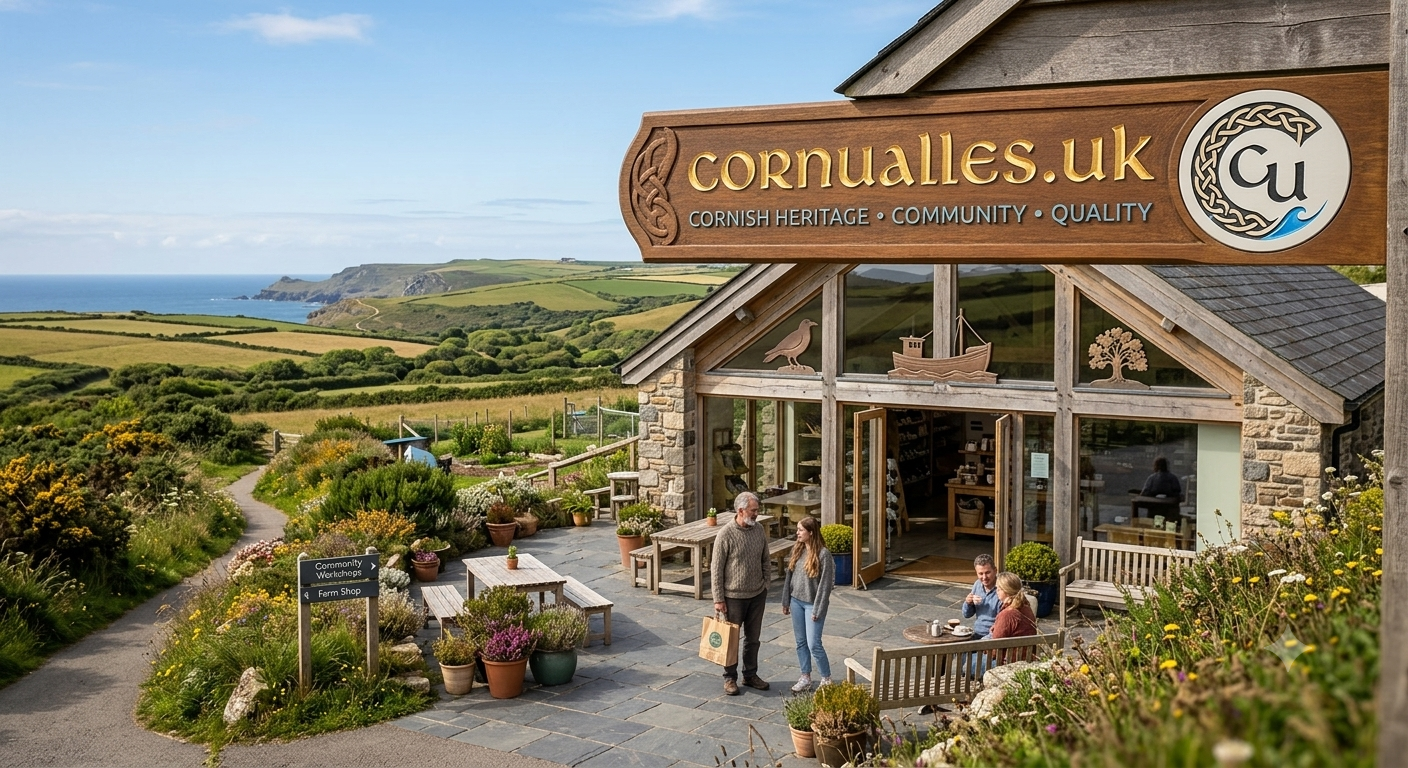
Cornualles.uk is the Spanish search term commonly used for Cornwall, United Kingdom, the rugged peninsula at England’s far southwestern edge. It is a place of Atlantic surf, fishing harbours, subtropical gardens, granite moorland, open-air theatre, mining heritage, and a Celtic identity that still shapes local life.
Yet Cornualles UK is not a destination to rush. Attractions that look close on a map may be separated by narrow lanes, summer traffic, tidal access, or long coastal walks. A successful visit depends as much on choosing the right base as selecting the right sights.
Editorial note: This guide was fact-checked in July 2026 using information from Visit Cornwall, Cornwall Council, GOV.UK, the National Trust, GWR, UNESCO, the Met Office, and the South West Coast Path Association. Opening times, fares, seasonal transport, tide windows, and entry requirements can change, so verify them before travelling.
Cornualles UK at a Glance
Cornualles UK belongs to England but has a distinct Cornish identity, represented by the black-and-white flag of Saint Piran and the revived Cornish language, Kernewek. Truro is Cornwall’s only city and administrative centre, although other towns often make more practical visitor bases.
The county rewards travellers who divide it into zones. The dramatic north coast suits surfers and cliff walkers, while the gentler south coast offers estuaries, gardens, and sailing towns. The far west feels wild and artistic, while inland Cornwall reveals moors, prehistoric remains, and historic mining landscapes.
| Planning fact | Practical answer |
|---|---|
| Country | England, United Kingdom |
| Local name | Cornwall in English, Kernow in Cornish, and Cornualles in Spanish |
| Main city | Truro |
| Recommended first visit | 5–7 days |
| Best all-round months | May, June, and September |
| Main rail gateway | Plymouth into Cornwall, followed by Bodmin Parkway, Truro, St Erth, and Penzance |
| Local airport | Cornwall Airport Newquay |
| Best known for | Coastlines, beaches, walking, surfing, art, gardens, food, and heritage |
| Currency | Pound sterling (GBP) |
| Driving side | Left |
What Is Cornualles UK, and Where Is It?
The phrase Cornualles UK does not describe a separate city or attraction. Cornualles is simply the Spanish name for Cornwall, a ceremonial county and peninsula bordered by Devon to the east and the Atlantic Ocean and English Channel around most of its coastline. The River Tamar forms much of the historic boundary with Devon.
This distinction matters when making reservations. Transport operators, accommodation platforms, road signs, and attraction websites use “Cornwall,” not “Cornualles,” so international visitors should search both variations. Do not confuse it with Cornwall in Canada, Cornwall in New York, or other places carrying the same English name.
A Celtic region within England
Cornwall’s character is more than a tourism theme. The UK Government recognised the Cornish as a national minority in 2014. In 2026, Kernewek received Part III recognition under the European Charter for Regional or Minority Languages, strengthening its status as a living regional language.
Cornwall had about 570,300 residents in the 2021 Census, of whom 18.1% identified as Cornish, according to the Office for National Statistics.
Visitors will see bilingual place names, Cornish products, and Saint Piran’s flags across the county. “Kernow” means Cornwall, while “Kernow bys vyken” roughly expresses “Cornwall forever.” Learning this background helps travellers engage with the destination as a living culture rather than decorative folklore.
Why the landscape looks different
Hard granite, exposure to Atlantic weather, drowned river valleys, and centuries of mining produced Cornualles UK’s unusual visual contrasts. The north coast is generally steeper and more exposed to Atlantic swell, while the south has sheltered creeks and natural harbours around Falmouth, Fowey, and the Helford River.
Mining is written into the scenery. The Cornwall and West Devon Mining Landscape became a UNESCO World Heritage Site in 2006. UNESCO notes that the region’s pioneering industries helped it produce two-thirds of the world’s copper supply during the early nineteenth century.
Why Visit Cornualles UK?
Cornualles UK works unusually well for travellers who want several types of holiday in one region. A single day might combine a harbour breakfast, modern art, a cliff walk, swimming, and dinner made with locally landed seafood—but only when those activities are grouped geographically.
Its greatest strength is variety at a human scale. Rather than relying on one headline monument, Cornualles UK offers a dense network of beaches, working ports, gardens, castles, museums, coastal paths, surf schools, artists’ studios, and independent food businesses.
Cornwall is especially rewarding for:
- Coastal walkers seeking short loops or multi-day sections of a National Trail.
- Families wanting beaches alongside weather-proof attractions.
- Surfers and swimmers who choose patrolled beaches and respect local conditions.
- Art lovers drawn to St Ives, Tate St Ives, and the Barbara Hepworth Museum.
- Garden enthusiasts visiting the Eden Project, Trebah, Glendurgan, and Heligan.
- History travellers exploring Tintagel, Pendennis Castle, Geevor Tin Mine, and engine houses.
- Food-focused visitors interested in pasties, seafood, farmhouse cheese, cider, and local produce.
Best Time to Visit Cornualles UK
The best time for Cornualles UK depends on whether sunshine, lower prices, swimming, walking, or quiet villages matters most. Cornualles UK’s maritime climate is comparatively mild, but “mild” does not mean reliably dry. Atlantic systems can bring wind and rain during any month.
For most first-time visitors, late May, June, or September offers the best compromise. Days are suitable for walking, attractions generally operate regular schedules, and demand is usually more manageable than during English school holidays in late July and August.
| Period | What it is like | Best for | Main trade-off |
|---|---|---|---|
| March–April | Spring colour, changeable weather, Easter demand | Gardens, coast walks, photography | Cool water and variable opening hours |
| May–June | Long days, active wildlife, generally lighter crowds | Best overall balance | Popular weekends still book quickly |
| July–August | Warmest and busiest period | Families, swimming, festivals | Higher rates, traffic, crowded car parks |
| September–October | Milder sea, softer light, fewer families | Couples, food, walking, surfing | Shorter days and increasing rain risk |
| November–February | Wild weather, quiet towns, lowest seasonal demand | Storm watching, cosy breaks | Closures, limited transport, rough conditions |
The Met Office’s location averages show why a single “Cornwall weather” figure can mislead. Conditions vary between Bude, inland Bodmin, Newquay, Camborne, and the south coast.
Pack a waterproof outer layer and shoes with reliable grip even when the forecast appears settled. Flexibility is more valuable than expecting Mediterranean weather, particularly around exposed headlands and elevated coastal paths.
Best Places to Visit in Cornualles UK
The best places in Cornualles UK are not all located along one convenient route. Choose one or two geographical clusters each day, allow time for parking or bus connections, and avoid pairing distant northern and far-western attractions simply because both appear on a “top ten” list.
Matching your accommodation base to your travel style can reduce daily driving, parking costs, and frustration more effectively than any attraction pass.
| Area | Choose it for | Strong nearby sights |
|---|---|---|
| St Ives and Hayle | Art, beaches, car-light travel | Tate St Ives, Hepworth Museum, Godrevy, west Cornwall railway |
| Newquay and north coast | Surfing, nightlife, families | Fistral Beach, Watergate Bay, Bedruthan coast |
| Padstow and Wadebridge | Food, cycling, estuary scenery | Camel Trail, Rock, Trevose Head, Port Isaac |
| Falmouth and Helford | Maritime culture, gardens, ferries | Maritime Museum, Pendennis, Trebah, Glendurgan |
| Penzance and Marazion | Far-west exploration | St Michael’s Mount, Mousehole, Porthcurno, Land’s End |
| Fowey and St Austell | South-coast villages and gardens | Eden Project, Lost Gardens of Heligan, Mevagissey |
| Bude | Quieter north Cornwall, beaches, walking | Summerleaze, sea pool, Hartland-area coast |
St Ives: beaches and modern art
St Ives combines a curved harbour, several beaches, distinctive coastal light, and one of Britain’s most important modern-art stories. Visit Tate St Ives and the Barbara Hepworth Museum, then walk to Porthmeor Beach or follow the coast toward Zennor if conditions and fitness allow.
Parking is the town’s main weakness during high season. A smarter Cornualles UK plan is to stay near the St Ives Bay branch railway or use the park-and-ride connection from St Erth, checking current railway arrangements before departure.
Newquay and Fistral Beach: the surf hub
Newquay is practical for travellers wanting surf schools, broad beaches, restaurants, and convenient access to Cornwall Airport Newquay. Fistral Beach is its most famous surfing location, but beginners should book a qualified lesson rather than assuming busy conditions are automatically safe.
The town is lively and convenient, although it may feel less intimate than Cornwall’s smaller harbour villages. Families often value its selection of beaches and indoor attractions, while couples seeking quieter evenings may prefer Mawgan Porth, Watergate Bay, or a rural property nearby.
Tintagel and Boscastle: legends and cliffs
Tintagel Castle layers dramatic geology, early medieval history, and later Arthurian legend on a headland connected by a striking footbridge. The site involves steps, exposed terrain, and timed admission, so check the current English Heritage visitor information instead of treating it as a quick roadside stop.
Pair Tintagel with Boscastle, a narrow natural harbour surrounded by a compact historic village, rather than driving across the county afterward. This section of the north coast offers powerful views, but its cliff paths require suitable footwear and caution during strong winds.
St Michael’s Mount and Marazion
St Michael’s Mount is a tidal island crowned by a medieval church and castle. At low tide, visitors can cross the ancient cobbled causeway from Marazion. At high tide, seasonal boats may operate, but access dates, weather, and sailing conditions must align.
This is one place where timing determines the entire visit. Consult the National Trust’s access guidance, reserve admission when required, and never assume that seeing the causeway means it will remain safe for your return journey.
Porthcurno and the Minack Theatre
Porthcurno places a turquoise-looking cove below the Minack Theatre, an open-air venue built into a spectacular cliffside setting. Book performances and daytime visits in advance, arrive early, and bring additional layers because wind and temperature can change even when nearby Penzance feels calm.
The PK Porthcurno museum tells the less obvious story of the submarine communications cables that connected Britain with the wider world. Combining the beach, theatre, and museum provides far greater value than treating Porthcurno as a brief photography stop before Land’s End.
Falmouth and the Helford area
Falmouth is one of the most balanced bases in Cornualles UK, especially for visitors travelling without a car. It offers railway access, harbour ferries, beaches, independent restaurants, the National Maritime Museum Cornwall, Pendennis Castle, and connections toward St Mawes and the Fal estuary.
South of town, Trebah and Glendurgan occupy sheltered valleys that support colourful and unusual planting. Garden lovers should allocate several hours instead of squeezing both attractions into one rushed afternoon. Visitors relying on buses should verify return frequencies before departure.
Eden Project and the Lost Gardens of Heligan
The Eden Project transformed a former clay pit near St Austell into a global garden and environmental attraction. Its huge biomes contain rainforest and Mediterranean environments, making it one of Cornualles UK’s strongest wet-weather options, although substantial walking between outdoor areas is still required.
The Lost Gardens of Heligan offer a different experience through historic estate gardens, woodland, productive areas, and a quieter atmosphere near Mevagissey. The two attractions are not interchangeable: Eden interprets global ecosystems, while Heligan focuses more strongly on restoration and estate history.
Padstow, the Camel Trail, and Port Isaac
Padstow combines a working harbour, acclaimed food businesses, and access to the mostly traffic-free Camel Trail toward Wadebridge and Bodmin. Reserve bicycles during popular periods and treat the route as a genuine half-day or full-day activity rather than an inconvenient addition between restaurant bookings.
Port Isaac is visually charming but compact, steep, and constrained by limited parking. Leave your vehicle in the designated upper car park, walk into the village, and remember that Port Isaac remains a living community rather than merely a filming location for Doc Martin.
Bodmin Moor and mining country
Bodmin Moor is the inland counterpoint to Cornualles UK’s beach image. It contains exposed granite, tors, grazing livestock, reservoirs, prehistoric remains, and rapidly changing weather. Walkers should carry an offline map, drinking water, protective layers, and a charged phone rather than relying on mobile coverage.
West Cornwall’s engine houses, including those around Botallack and Levant, reveal how mining shaped the landscape and influenced global industry. The UNESCO designation covers ten component areas, so there is no single World Heritage entrance. Plan around a specific mine, museum, or walking route.
How Many Days Do You Need in Cornualles UK?
Three days can introduce one part of Cornualles UK, but they cannot cover the entire county comfortably. Five days suit a focused first visit, while seven days allow time for northern, far-western, and southern clusters without turning every morning into another early departure.
The following itineraries use geographical logic rather than collecting famous names. Keep one flexible block for rain, rough seas, or a change of pace. Cornwall is at its best when your schedule can bend.
Three-day Cornwall itinerary
Base yourself in Penzance, St Ives, or Falmouth, rather than midway between all three. Explore your chosen base on foot on the first day, visit one nearby headline attraction on the second, and add a coastal walk or garden before departure.
- Day 1: St Ives harbour, Tate St Ives, and Porthmeor Beach.
- Day 2: St Michael’s Mount during a safe tide window, followed by Penzance or Mousehole.
- Day 3: Porthcurno and the Minack Theatre, or a Falmouth-and-gardens itinerary.
Five-day Cornwall itinerary
For five days in Cornualles UK, divide your stay between west Cornwall and either Falmouth or the north coast. Changing accommodation once saves repeated cross-county journeys without creating the inconvenience of moving every night.
- Days 1–2: St Ives, Godrevy, or a short west-coast walk.
- Day 3: Marazion, St Michael’s Mount, and Mousehole.
- Day 4: Porthcurno, the Minack Theatre, and a far-western viewpoint.
- Day 5: Falmouth and Pendennis Castle, or Tintagel and Boscastle when staying farther north.
Seven-day Cornwall itinerary
A full week supports a more complete Cornualles UK route. Spend three nights in the west, two around Falmouth or Fowey, and two near Padstow, Newquay, or Tintagel. Adjust the order according to your arrival transport.
- Days 1–2: St Ives, modern art, beaches, and a coastal walk.
- Day 3: St Michael’s Mount and the villages around Mount’s Bay.
- Day 4: Porthcurno, the Minack Theatre, and mining country.
- Day 5: Falmouth, a Fal ferry trip, or Trebah Garden.
- Day 6: Eden Project or Heligan, followed by the journey north.
- Day 7: Padstow and the Camel Trail, or Tintagel and Boscastle.
Getting to and Around Cornualles UK
Cornualles UK is accessible by railway, road, coach, and air, but the best choice depends on your accommodation base. Travelling from London by train avoids a long drive and works particularly well for St Ives, Truro, Falmouth, and Penzance.
Peak-season road congestion is real. Visit Cornwall recommends travelling outside the busiest periods, while Cornwall Council manages more than 300 car parks and publishes current locations and rules through its official parking portal.
Travelling by train
Great Western Railway operates services from London Paddington through Devon into Cornualles UK, with branch lines serving destinations including St Ives, Falmouth, Looe, and Newquay. The Night Riviera Sleeper connects London and Penzance six nights each week.
Book advance fares when your plans are fixed, but compare the potential saving against the loss of flexibility. Rail travellers should choose accommodation near a station or frequent bus corridor and investigate the final connection carefully before paying.
A property described as “near St Ives” may still prove impractical without a vehicle. Check the exact address, walking terrain, bus timetable, and taxi availability instead of relying on the town name shown in the accommodation listing.
Travelling by air
Cornwall Airport Newquay operates changing seasonal and year-round routes. Confirm the precise 2026 schedule rather than relying on an outdated route map or travel article.
International visitors may also fly into Bristol, Exeter, London, or another UK airport and continue by train or rental car. Compare the complete door-to-door journey because the nearest airport does not always provide the quickest or most affordable route.
Entry requirements for international visitors
Most visitors from Europe and several other visa-exempt countries now need a UK Electronic Travel Authorisation before travelling. GOV.UK states that an ETA currently costs £20 and normally permits multiple visits over two years or until the linked passport expires.
An ETA gives permission to travel but does not guarantee admission at the border. Use the official UK visa and ETA checker, because requirements depend on nationality, immigration status, travel purpose, and the passport being used.
Do you need a car?
A car is not essential for a carefully designed Cornualles UK holiday based in Falmouth, St Ives, Penzance, Truro, or Newquay. Trains, buses, walking routes, and seasonal ferries can create a satisfying itinerary, and the National Trust lists car-free access to several major properties.
A vehicle becomes valuable for remote cottages, early departures, Bodmin Moor, smaller coves, and multi-base trips. Select the smallest practical rental car, use designated car parks, download offline maps, and never follow satellite navigation down a lane that is visibly unsuitable.
Cornwall Beaches, Walking, and Safety
Beach and cliff safety should shape every Cornualles UK itinerary. The sea can appear calm while rip currents, cold water, changing tides, submerged rocks, or powerful swells create serious danger. Cliff edges can also become unstable after heavy rain or erosion.
Choose an RNLI-lifeguarded beach when swimming, remain between the red-and-yellow flags, and ask lifeguards about current conditions. Cornwall Council advises visitors to use patrolled beaches and provides official beach safety information.
Essential coastal safety rules include:
- Check tide times before visiting coves, causeways, caves, or beach walking routes.
- Keep away from cliff edges and never stand below visibly unstable cliffs.
- Wear shoes with reliable grip because short coast routes may contain steep climbs.
- Do not use inflatables when the wind is blowing offshore.
- Call 999 or 112 and ask for the Coastguard during a coastal emergency.
- Remove your litter and avoid disturbing seals, nesting birds, and marine wildlife.
- Never enter unfamiliar water alone.
- Check whether lifeguard coverage is operating on the day of your visit.
The complete South West Coast Path runs for 630 miles, including approximately 296 miles across its north, west, and south Cornwall sections. Walkers do not need to complete the entire trail to enjoy it.
Do not estimate difficulty using mileage alone. Repeated descents and steep climbs can make ten coastal miles significantly more demanding than ten miles across level urban terrain. Weather, muddy surfaces, exposed cliffs, and limited exit points can add further difficulty.
Food, Culture, and Responsible Travel
Food is one of the easiest ways to understand Cornualles UK beyond its scenery. Try a properly crimped Cornish pasty, locally landed fish, crab, mussels, Cornish Yarg, saffron buns, farmhouse ice cream, and a traditional cream tea.
In Cornwall, the local tradition places jam on the scone before clotted cream. This seemingly minor detail forms part of a long-running regional distinction between Cornish and neighbouring Devon customs.
Look for businesses using local supply chains rather than assuming every harbour restaurant serves locally sourced seafood. Reservations are sensible for destination restaurants, but bakeries, markets, farm shops, and unfussy pubs often provide a more grounded picture of Cornish food culture.
Travel with less impact
Tourism supports employment but also increases pressure on roads, housing, footpaths, water supplies, and small communities. Stay longer in fewer bases, spend with independent businesses, and travel outside the busiest summer weeks when possible.
Use refillable bottles and consider trains, buses, bicycles, ferries, or walking for suitable journeys. Reducing unnecessary driving can improve the holiday itself by removing parking searches and allowing travellers to experience the landscape at a slower pace.
Respect access rules and private property, especially around farms, harbours, and fishing infrastructure. Do not block gateways, disturb livestock, climb on working boats, or enter restricted mining structures.
Seasonal dog restrictions vary by beach. The Cornwall Council 2026 list shows that restrictions commonly apply between 10 a.m. and 6 p.m. during specified summer dates, while protected wildlife areas may prohibit dogs throughout the year.
Cornualles UK Budget and Booking Strategy
A Cornualles UK trip can be moderately priced or expensive, but season and location influence costs more than attraction tickets. Seafront rooms, school-holiday cottages, last-minute train fares, restaurant dinners, and daily parking charges can quickly increase the total.
Camping, advance train tickets, self-catering accommodation, free coastal walks, and car-light bases can reduce expenses. Travelling during May, June, September, or early October may also provide better value than the late-July and August peak.
Avoid setting a rigid daily budget months before travelling. Instead, price the five largest categories—transport to Cornwall, accommodation, local mobility, food, and booked attractions—using your exact dates.
Add a 10–15% contingency for weather-related changes, unexpected transport, parking, or additional indoor attractions. A financial buffer prevents one rainy day or missed connection from disrupting the remainder of the trip.
Follow this booking order:
- Choose the region and dates according to your interests, not simply the cheapest available room.
- Reserve accommodation with a workable parking or public-transport arrangement.
- Book fixed transport, especially advance railway tickets or flights, after confirming the stay.
- Reserve capacity-limited experiences such as performances and timed castle visits.
- Check tide-dependent plans again shortly before the relevant day.
- Keep at least one indoor attraction or flexible half-day available.
Common Cornualles UK Planning Mistakes
The most common Cornualles UK mistake is underestimating journey times. A route planner may display a modest distance but cannot fully communicate summer queues, single-track lanes, infrequent buses, parking searches, or the walk from an outer car park.
Another mistake is building the trip around social-media images instead of operational details. A tidal island, remote cove, clifftop theatre, or tiny harbour may require booking, safe tide timing, physical effort, or a backup plan.
Avoid these common errors:
- Trying to visit both coasts every day: Build geographical clusters instead.
- Using Land’s End as the only far-western goal: Porthcurno, Sennen, mining sites, and coastal walks often provide richer experiences.
- Assuming every beach is safe for swimming: Choose lifeguarded beaches and follow the flags.
- Booking a remote cottage without a transport plan: Verify the final connection before paying.
- Ignoring weather variability: Pack layers and retain an indoor alternative.
- Driving into historic harbour centres: Use designated outer car parks.
- Treating Cornwall as culturally generic England: Learn about Kernewek, mining, fishing, and local identity.
- Expecting mobile coverage everywhere: Save maps, tickets, addresses, and essential numbers offline.
- Overloading each day: Plan one significant experience per half-day.
- Ignoring tide times: Check them before visiting causeways, coves, caves, or beaches with restricted access.
Frequently Asked Questions About Cornualles UK
The following answers address the most common questions travellers ask before visiting. Current schedules, access restrictions, entry requirements, and attraction details should still be checked before booking.
For a first visit, prioritise one strong experience per half-day. Cornwall rewards time to walk, wait for the tide, explore local businesses, and respond to the weather more than an overloaded checklist of distant landmarks.
Is Cornualles UK the same place as Cornwall?
Yes. Cornualles is the Spanish name for Cornwall, while “UK” indicates the United Kingdom. Use “Cornwall” when searching for British train tickets, road directions, hotels, or official attraction websites because that is the locally used English name.
How many days are enough for Cornwall?
Allow at least five days for a useful first trip and seven days for a more balanced route. Three days can work when you choose one base and one region, but they are insufficient for exploring north, west, and south Cornwall without excessive driving.
What is the best month to visit Cornualles UK?
June is arguably the strongest all-round month because days are long and the main school-holiday rush has usually not started. May and September are also excellent, especially for walking and lower crowd pressure, although weather remains changeable throughout the year.
Can you visit Cornwall without a car?
Yes, provided your itinerary is designed around railway-connected bases such as St Ives, Falmouth, Penzance, Newquay, or Truro. Use branch-line trains, buses, ferries, and walking routes for nearby geographical clusters.
Avoid booking isolated accommodation unless you have confirmed a reliable bus, taxi, or private transfer. Always check evening and Sunday transport frequencies because they may differ significantly from weekday daytime schedules.
Which airport is closest to Cornualles UK?
Cornwall Airport Newquay is the county’s local commercial airport and is convenient for Newquay and parts of northern and central Cornwall. Route availability can be seasonal, so Bristol, Exeter, or London airports may offer better connections for some travellers.
Is Cornwall expensive to visit?
Cornwall can become expensive during the main school holidays, especially for seafront accommodation, rental cottages, parking, and last-minute travel. Visiting outside peak summer, booking trains early, choosing self-catering accommodation, and using free coastal attractions can keep the trip more affordable.
Is Cornwall suitable for families?
Yes. Cornwall offers family-friendly beaches, gardens, castles, museums, aquariums, cycling routes, and attractions such as the Eden Project. Families should choose beaches with active lifeguard coverage and keep flexible indoor plans for rainy or windy days.
Can visitors swim in Cornwall?
Swimming is possible at many Cornish beaches, but conditions vary considerably. Choose an RNLI-lifeguarded beach, remain between the red-and-yellow flags, avoid entering unfamiliar water alone, and never assume that calm-looking water is free from currents.
Conclusion: Plan Cornualles UK by Region, Not by Checklist
Cornualles UK delivers its best experiences when you slow the route down. Choose a base that matches your priorities, group attractions by coast, check tides and transport, reserve capacity-limited activities, and retain flexibility for weather.
Start with west Cornwall for art and dramatic scenery, the north coast for surfing and cliffs, the south for gardens and estuaries, or inland Cornwall for moorland and mining heritage.
Once you have selected the right region, reserve accommodation with the final connection in mind. Verify current travel permissions through GOV.UK, confirm tide-dependent visits, and include one flexible day in your itinerary. That approach creates a richer Cornualles UK experience than racing between every famous landmark.
